
Visa API Integration
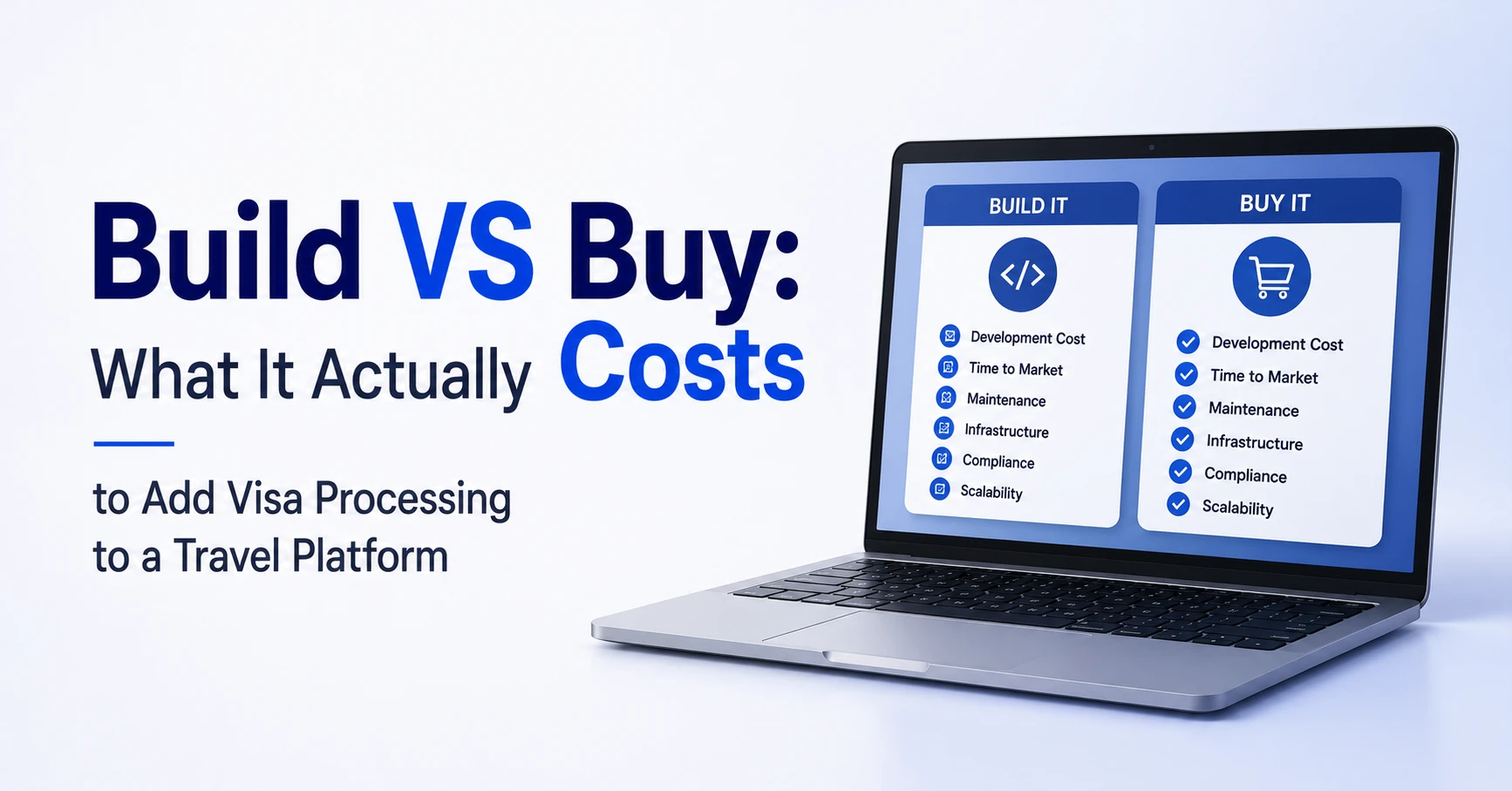
Build vs. Buy: What It Actually Costs to Add Visa Processing to a Travel Platform
Introduction: The Hidden Cost of Building vs Buying Visa Processing
Building visa processing in-house means owning ongoing compliance changes across every destination you support. That is the cost most teams underestimate, not the initial build.
Every new rule, authentication tweak and portal update becomes your engineering team's responsibility. These changes keep draining resources long after launch.
By contrast, buying an eVisa API for booking site integration shifts that maintenance burden to a vendor. It turns a multi-month engineering project into an integration measured in days.
So instead of firefighting government-portal volatility, your developers can focus on growth. This piece breaks down what each path actually costs, and why "build" often looks cheaper than it is.
We will also look at how "buy" options like APIs or white-label apps change the economics of scaling visa services.
Building in-house means paying for engineering time twice: once to build it, then continuously to track visa rule changes across every destination you support.
Buying a travel visa API converts this into a predictable cost and shifts compliance upkeep to the vendor. But the real build-vs-buy question isn't "API vs. no API." It is API vs. white-label visa integration. Both are "buy," just at different levels of control.
Break-even favors buying unless visa processing is a core, differentiated part of your product. Let's look at how to integrate a travel visa API, and when it makes sense.
What is the Real Cost of Building In-House?
Some companies choose to build visa processing integrations themselves. They often underestimate the major cost centers that emerge after launch.
The upfront engineering effort is only the beginning. Government portal volatility, recurring maintenance and hidden budget drains compound the cost quickly.
Add the diversion of engineering talent away from growth initiatives, and the "build" path becomes far more resource-intensive than most budgets anticipate.
Sustaining an in-house visa integration means repeatedly assigning senior talent to firefight compliance changes instead of scaling the product.
The latest U.S. Bureau of Labor Statistics (BLS) data puts the median annual wage for software developers at $135,980 (May 2025), with wide variation by experience level and location. Every week of that time spent on visa-rule maintenance is a real cost.
The Five Real Cost Centers of Building In-House
| Cost Layer | What Does It Cover? | What is the Impact? |
|---|---|---|
| Upfront Engineering | Weeks of developer hours for API scoping, data mapping, QA and project oversight. | High initial resource drain; delays go-live timelines. |
| Government Portal Volatility | Recurrent format changes, new compliance rules and authentication tweaks. | Silent breakages, failed submissions and urgent firefighting. |
| Recurring Maintenance | Continuous monitoring and urgent fixes. | Requires senior engineering bandwidth. |
| Hidden Budget Drain | Unplanned sprints not accounted for in budgets. | Margins eroded over time; unpredictable engineering costs. |
| Talent Diversion | Engineers pulled into reactive maintenance instead of growth projects. | Slows innovation, reduces competitive differentiation. |
Why This Cost Evaluation Matters
- Escalating talent expenses: Engineering salaries keep rising, which pushes up the cost of building and maintaining in-house.
- Opportunity cost is real: Every sprint spent patching visa integrations is a sprint not spent on product innovation.
- Predictability favors buying: A travel visa API shifts compliance upkeep to the vendor. This converts unpredictable engineering costs into a predictable subscription.
Travel visa API pricing typically follows usage-based models such as per-request fees, revenue share, subscription tiers, or freemium plans.
What You Are Actually Paying For with an API
When teams evaluate travel visa API pricing, the key is understanding that most vendors follow a usage-based structure. Instead of fixed engineering salaries or unpredictable maintenance sprints, you pay for the actual API calls or applications processed.
This model scales with demand. Smaller agencies avoid over-investing upfront, while larger OTAs can budget predictably as volumes grow.
The vendor absorbs the compliance upkeep, and you get continuously updated travel visa API documentation that keeps the integration stable. This lowers the overall visa processing integration cost.
What is Typically Included in Travel Visa API Pricing?
| Usually Included | Often Billed Separately |
|---|---|
| Data maintenance and rule updates. | Very high-volume tiers. |
| Uptime SLA. | White-glove onboarding / dedicated support. |
| Core requirement and document checks. | Application submission, where offered as an add-on. |
This framing makes clear that buying an API isn't only about integration speed. It also shifts compliance risk away from your team.
It reduces engineering overhead and gives you a predictable managed service with a clear, vendor-managed cost model.
API vs. White-Label App: The Question Under the Question
Most teams frame the decision as "build vs buy software." In visa processing, that's not the real fork in the road. So how should you integrate a travel visa API?
Once you decide not to build in-house, you're actually choosing between two very different "buy" paths: integrating an API or adopting a white-label app.
One of the clearest wins on the "buy" side is automating UK and Canada ETA approvals, where the paperwork is straightforward but the volume makes manual handling impractical.
API Integration: Control and Branding
An API integration keeps your platform's own UI, brand and customer experience intact. You control the look and feel, decide how visa steps appear in your booking flow, and keep ownership of the customer journey.
It is more work upfront than a turnkey app, but it preserves brand equity and lets you differentiate.
White-Label App: Speed and Simplicity
A white-label app, on the other hand, is faster to launch. You get a ready-made portal under your logo, but the vendor controls most of the UX and feature set.
That speed comes at the cost of flexibility. You can't easily customize flows or embed visa steps deep into your existing checkout.
The Real Decision Point
This is the real decision most teams face: not whether to use an API at all, but whether to prioritize speed and simplicity with a white-label app or invest in control and branding with an API.
Framing the choice this way is far more useful than the binary "build vs buy software" lens, because it reflects the actual trade-offs in market capture and customer experience.
A Simple Framework for Deciding
Choosing between building in-house and buying a visa API isn't about gut instinct. It is about scoring yourself against three practical questions.
Think of this as a quick decision scorecard. The more "build-leaning" answers you give, the stronger the case for building. The more "buy-leaning" answers, the stronger the case for integrating an API or a white-label solution.
Is visa processing core to your product or a supporting feature?
If it's central to your differentiation, building may make sense. If it's a supporting feature, buying avoids unnecessary complexity.
Do you have, or want, a team dedicated to compliance monitoring?
Owning government portal changes requires ongoing engineering bandwidth. If you don't want a compliance team, buying shifts that burden to the vendor.
What's your time-to-launch requirement?
Extended build cycles can delay market entry. Buying compresses integration into days or weeks instead of months.
By answering these three questions honestly, the team can score itself and see whether the balance tilts toward building or buying.
The framework not only helps you score the decision; it also points to how to integrate a travel visa API when "buy" is the right answer.
Travel agencies that decide to buy eventually need more than a checkout-level API. They need an established visa management platform to run the whole application lifecycle.
Build In-House vs. Buy an API vs. White-Label App
| Factors | Build In-House | Buy: API Integration | Buy: White-Label App |
|---|---|---|---|
| Time to Launch | Months (build + compliance review). | Days to weeks. | Days. |
| Ongoing Compliance Upkeep | Your team's responsibility. | Vendor's responsibility. | Vendor's responsibility. |
| Brand / UI Control | Full. | Full: your own UI calls the API. | Limited: vendor's UI with your logo. |
| Best Fit | Visa processing is a core, differentiated product. | You want control and already have engineering capacity. | You want the fastest possible launch. |
Moving Forward: Skip the Build. Integrate the API.
YourVisa.ai's eVisa API for booking site integration gets visa checks and processing live in days, with compliance upkeep handled on our side.
Instead of sinking months into engineering and compliance monitoring, you can launch faster, keep your brand experience intact, and rely on predictable, vendor-managed costs.
Compare Travel Visa API Pricing and Documentation View API documentation
FAQs
Is it cheaper to build a visa API in-house or buy one?
Buying is usually cheaper in total cost of ownership once ongoing compliance monitoring is counted. The exception is when visa processing is a core, differentiated part of your product that justifies a dedicated team.
What is the difference between an API integration and a white-label visa app?
An API integration keeps your own interface and brand, and calls the vendor's API for the data underneath. A white-label app is the vendor's pre-built interface with your branding applied on top. It is faster to launch but gives you less control.
How long does it typically take to integrate a travel visa API?
Most booking platforms can integrate a well-documented travel visa API in days to weeks. An in-house build plus compliance review takes considerably longer.
What ongoing costs does 'buying' still involve?
Usage-based API fees, and tiered pricing for higher volume or added destinations, can increase travel visa API pricing. What you don't pay for is the engineering headcount needed to track rule changes yourself.
Does buying an API mean giving up control over the user experience?
Not with an API integration. You keep your own UI and just call the API for data. Control is only reduced with a white-label app, since it uses the vendor's own interface.