
Group Travel
How to Plan a Group Trip Abroad: The Complete Visa, eVisa, Passport and Logistics Guide for Group Organizers
How to plan a group trip abroad starts with one simple principle: begin early and sort out documents before booking details become urgent.
The best approach is to start at least 6 months out, check each traveler's passport validity and nationality, work out whether they need a visa, an eVisa or an ETA, and then collect everything through a single roster rather than dozens of email threads.
A shared process avoids confusion when travelers have different nationalities, passport expiry dates or entry requirements. It also lets organizers spot problems before they affect the itinerary or the budget.
A group travel visa service can take the hassle out of gathering documents and tracking applications by keeping all traveler information in one place, rather than spread across several inboxes and spreadsheets.
The order matters. One traveler without the right authorization can hold up the whole group trip. It's far better to get passports, nationality checks and authorizations sorted first, then build the rest of the trip around them.
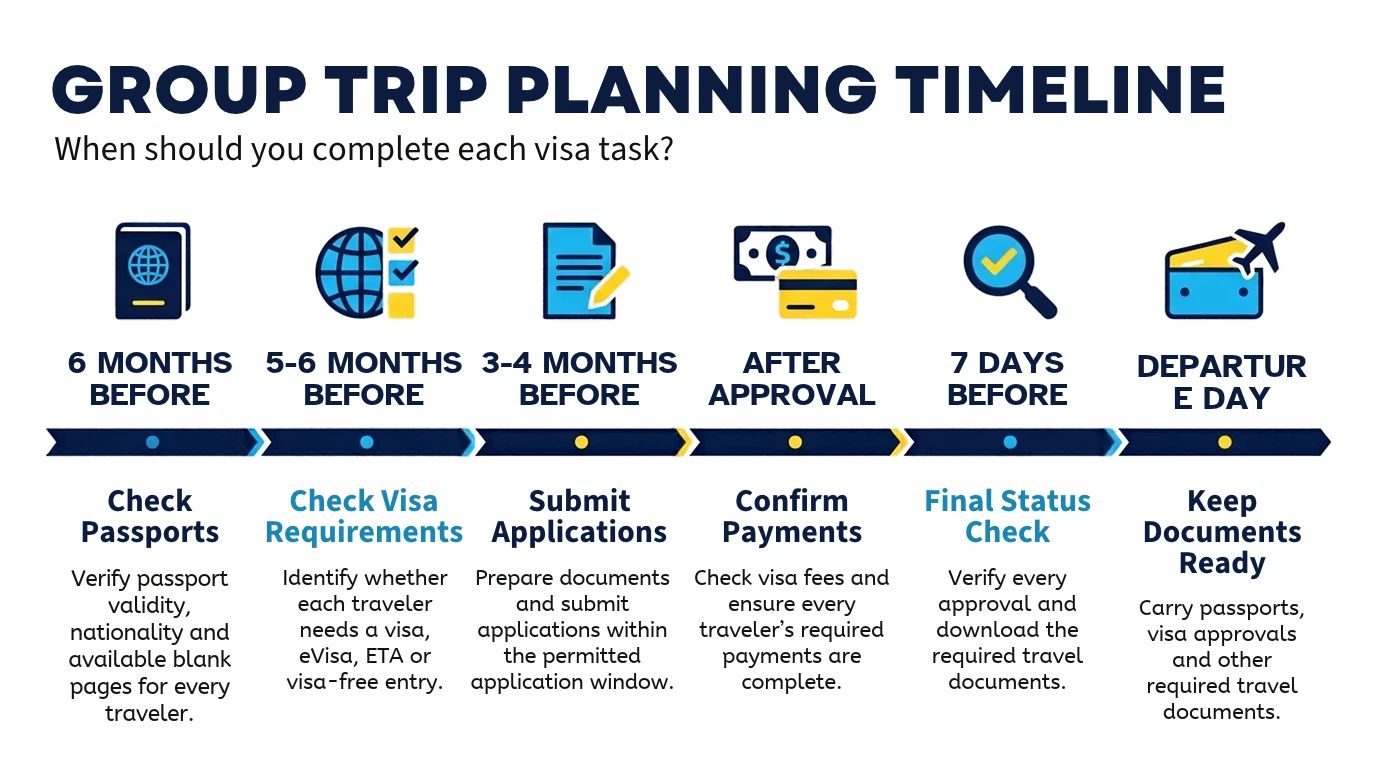
To keep an international group trip on track, work through these six stages in order:
- 6 months before departure: Check passport validity, condition and blank pages.
- 5-6 months before departure: Check the visa, eVisa, ETA or other entry requirement for each traveler's nationality.
- 3-4 months before departure: Submit your applications (or as early as the destination allows).
- 2-3 months before departure: Collect payments and sort out any missing documents.
- 7 days before departure: Do a final status review and confirm all approvals have been issued.
- On departure day: Take your passports, travel authorizations, booking confirmations and emergency contact details.
Start with the documents rather than the logistics. It reduces the risk of delays, and you can be sure every traveler is ready to go on departure day.
What Does Planning a Group Trip Abroad Involve?
If you're wondering how to plan a group trip abroad, it gets a lot easier once you split it into three separate workstreams: travel logistics, travel documents and finances.

Each track has its own deadlines, owners and risks, but they all have to move forward together for the trip to succeed.
The three core pillars of group travel planning
The first track is travel logistics: flights, hotels, room assignments, airport transfers, activities and the itinerary.
These are usually the most visible parts of the trip, because travelers deal with them directly. They're not necessarily the most important early planning tasks, though.
Track two is documentation. That means passports, visas, eVisas, ETAs and any other travel authorizations you might need. Of the three tracks, this is usually the hardest part of group travel planning, because organizers don't control the deadlines.
Embassies, consulates and government immigration systems set the application windows, processing times and approval requirements. Missing one deadline can keep a traveler off the trip, even if their flights and accommodation are already paid for.
Track three is money. You need to decide how deposits will be collected, who pays for travel documents, how refunds will work, and whether costs are paid centrally or individually. Settle all of this at the start to avoid confusion later.
Six-month planning timeline, tasks and ideal ownership
- 6 months before departure: Verify passport validity and traveler nationality. Who owns it: Traveler.
- 5-6 months before departure: Review visa, eVisa and ETA requirements. Who owns it: Organizer.
- 4-5 months before departure: Collect traveler information and supporting documents. Who owns it: Organizer.
- 3-4 months before departure: Submit applications and address missing documents. Who owns it: Traveler.
- 2-3 months before departure: Confirm flights, accommodations and transfers. Who owns it: Organizer.
- 1 month before departure: Review approval status for every traveler. Who owns it: Organizer.
- 7 days before departure: Final document and itinerary check. Who owns it: Organizer & Traveler.
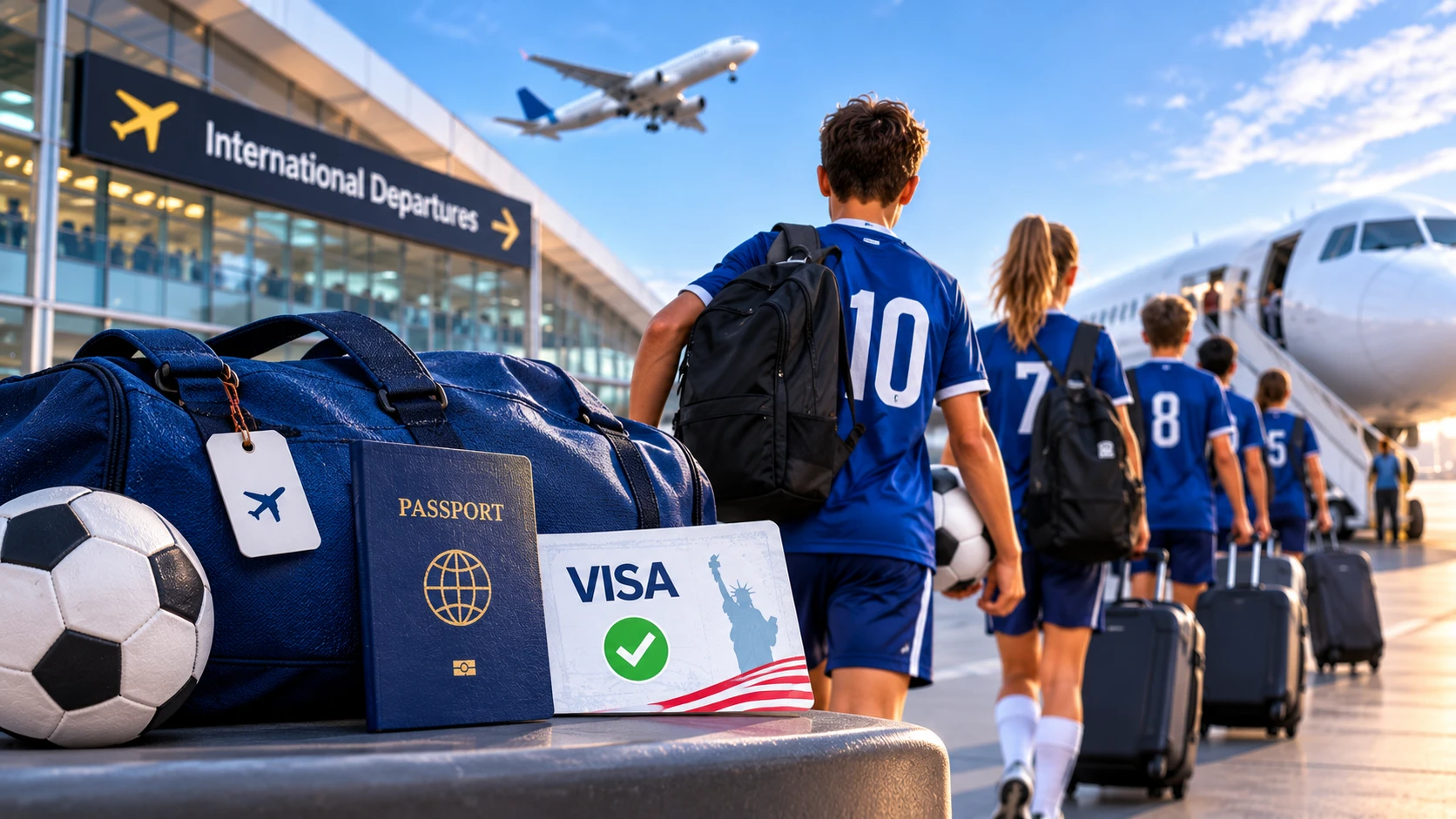
Successful trips usually start with the document track rather than the travel bookings. Flights can often be rebooked and hotels changed, but the immigration timeline is largely fixed.
Start with passports, nationality checks and travel approvals. That way you know every person in the group is eligible before you commit any money. A single missing approval can affect the whole group's plans.
Check Every Traveler's Passport and Nationality
Before looking at visas or flights, make sure every traveler has a passport that meets the destination's entry requirements.
This sounds simple, but passport problems are one of the most common reasons a traveler runs into trouble before departure.
The first check is validity. Many destinations require a passport to stay valid for a set period beyond the travel dates. Requirements vary from country to country, so organizers should always check the rules for the destination.
For example, to enter the Schengen Area, a passport generally needs to be valid for at least three months beyond the date you plan to leave the Area. It must also have been issued within the previous 10 years. So a passport that hasn't expired may still not meet the entry requirements.
Review passport validity before booking travel
Many travelers check only the expiry date and assume that's enough. Entry rules vary from country to country, so review them well in advance.
If a renewal is needed, build extra processing time into the travel schedule. For U.S. travelers, renewal times are set out in the U.S. passport guidance from the State Department, so factor them into the planning calendar.
Collect nationality information, not just passport numbers
A passport number on its own doesn't tell you what a traveler needs. Their citizenship does. Two people on the same itinerary can need completely different documents simply because they hold different passports.
One traveler may be eligible for visa-free entry, while another needs an eVisa, an ETA or a consular visa for the same destination.
That's why organizers should keep a traveler roster that includes nationality and passport details, so they can assess document requirements properly before any applications start.

Decide early for dual nationals
Travelers with two or more passports should decide which one they'll use for the trip before submitting any applications.
Visa approvals, airline bookings and travel authorizations must all match the same passport. Switching documents later only causes delays and extra admin.
Check passport condition and blank pages
A valid passport isn't always a usable passport. Torn pages, water damage, a detached cover or unreadable details can all cause problems at check-in or at border control.
Some destinations also require a minimum number of blank pages for entry stamps or visas. A passport and nationality audit six months before departure helps you spot these problems early.
It gives travelers enough time to renew documents, correct errors and complete the next stages of the process.
Group Travel Visa Check: Do Group Members Need a Visa, an eVisa or an ETA?
One of the most important parts of international trip planning is working out which type of travel authorization each person needs.
Depending on the destination and the traveler's nationality, that could be a traditional visa, an eVisa, an ETA or, once it launches, an ETIAS travel authorization for Europe.
Many organizers use the term group travel visa to describe the overall process of getting travel approvals for everyone in the group. In practice, though, most countries issue approvals to individuals, even when travelers share the same itinerary.
Understanding the different document types
- Visa
How it is obtained: Through a consulate, embassy or visa center.
Who applies: Individual traveler.
Typical lead time: Weeks to months.
Typical validity: Varies by country. - eVisa
How it is obtained: Online government application system (e.g., India, Brazil, Vietnam).
Who applies: Individual traveler.
Typical lead time: Days to weeks.
Typical validity: Varies by country. - ETA
How it is obtained: Electronic travel authorization (e.g., UK ETA, Canada eTA, U.S. ESTA).
Who applies: Individual traveler.
Typical lead time: Usually days.
Typical validity: Varies by program. - ETIAS
How it is obtained: Planned EU online travel authorization, not yet in operation. Start date not yet known, expected sometime in 2027.
Who applies: Individual traveler (an authorized third party can apply on their behalf).
Typical lead time: Expected to be short once live.
Typical validity: Planned: three years or until the passport expires.
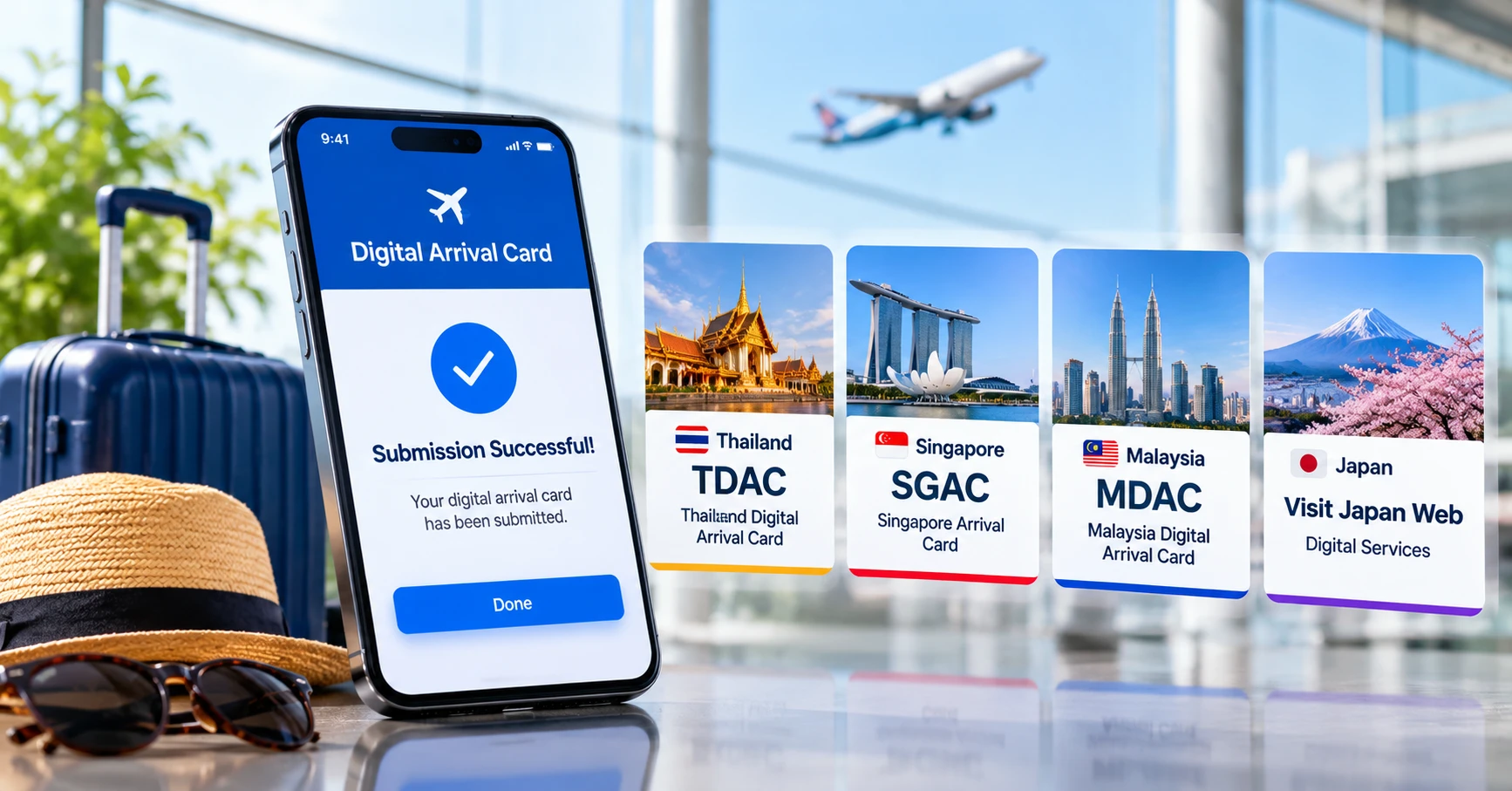
Most groups still apply individually
A common misconception is that there's a special Schengen group visa for tour organizers. In reality, Schengen countries generally issue visas to individual travelers, not to the group as a single entity.
Each traveler must qualify and receive their own approval, although travel agencies and tour operators can handle visa processing for tour groups on behalf of their travelers.
The same principle applies at most destinations. Even when a group travels together, border authorities normally assess each person's eligibility separately.
Organizers should therefore track approvals traveler by traveler rather than assume one application covers everyone.
What about a tourist group visa?
A tourist group visa does exist in a small number of destinations for officially organized tour groups, but these programs are the exception rather than the rule.
Eligibility, the application process and the definition of a group vary from country to country. Before you go down the group route, confirm with the destination that a group option actually exists and check the exact requirements.
Check requirements by nationality
Nationality is often the deciding factor. One traveler may qualify for visa-free entry, another may need an ETA, and a third may need a full visa application for the same destination. This is why nationality reviews should be done before collecting applications.
When organizers treat travel approvals as a traveler-by-traveler process, they spot issues sooner, avoid surprises and keep the whole group moving through the application process on schedule.
How Far in Advance Should You Start?
The short answer: earlier than you think. Most organizers focus on flights and accommodation first, but travel approvals often decide whether a traveler can join the trip at all.
If you're learning how to plan a group trip, a good rule is to start document reviews at least six months before departure.
Different travel documents have different timelines. Traditional visas usually need the most planning, because appointments, document reviews and government processing times can all affect the schedule.
Different documents, different deadlines
Under the EU Visa Code, Schengen visa applications can generally be lodged up to six months before travel and no later than 15 calendar days before departure. Waiting for the minimum window is rarely a good idea, especially for larger groups.
eVisas and ETAs are often processed much faster and can be approved in days rather than weeks. Even so, organizers shouldn't leave these applications to the last moment.
Government systems can slow things down too: website maintenance, high demand, processing delays or requests for more information. Starting early gives you breathing space to deal with surprises without touching your travel dates.
Build your timeline around the slowest traveler
One of the most common planning mistakes is setting the schedule by average processing times. International travel groups rarely move at the same pace.
Some travelers need passport renewals, some need consular visas, and others may need extra supporting documents because of their nationality or travel history.
Effective group travel planning centers on the traveler who will take the longest to become travel-ready.
If one person needs extra processing time, build the whole group schedule around that. Otherwise, organizers are likely to be making last-minute changes while one approval is still pending.
Build flexibility into your timeline
A practical approach is to leave a buffer between the date you expect the documents to be ready and the date you actually leave.
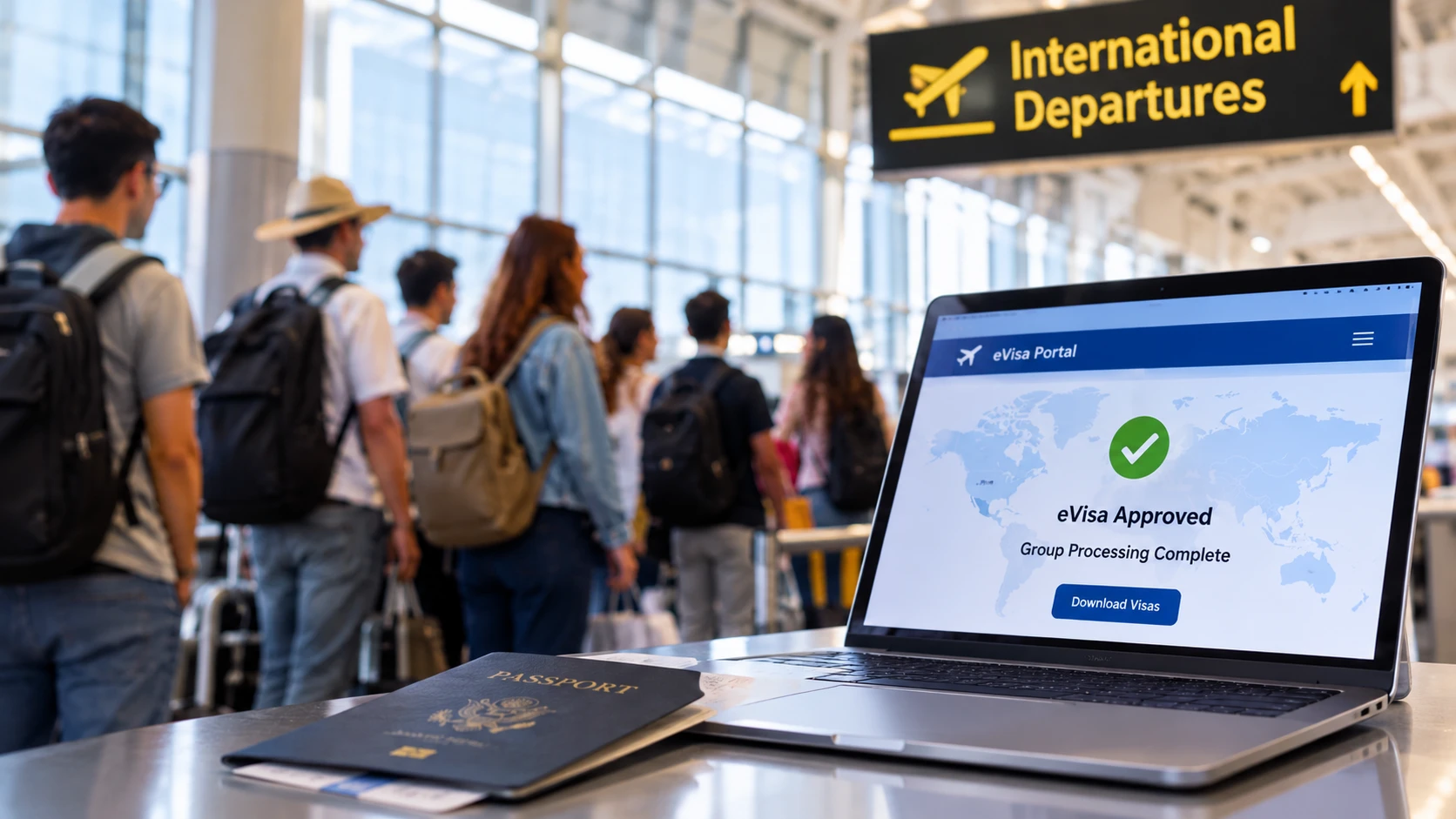
This buffer leaves time for corrections, extra document requests, application delays or sudden changes to travel rules.
Starting six months out may feel like overkill in some cases, but it gives you room to deal with approvals, renewals and exceptions without undue stress.
When you plan around the slowest traveler rather than the average one, the whole trip becomes far more predictable and manageable.
How to Collect Documents From 20+ Travelers Without Chasing
The admin side of a group trip grows with every person you add. With 20, 30 or more people, it can quickly become a nightmare. What's manageable for a group of five can turn into a real problem at scale.
Long email chains, missing attachments and last-minute document requests make it hard to track who has done their part and who still needs chasing.
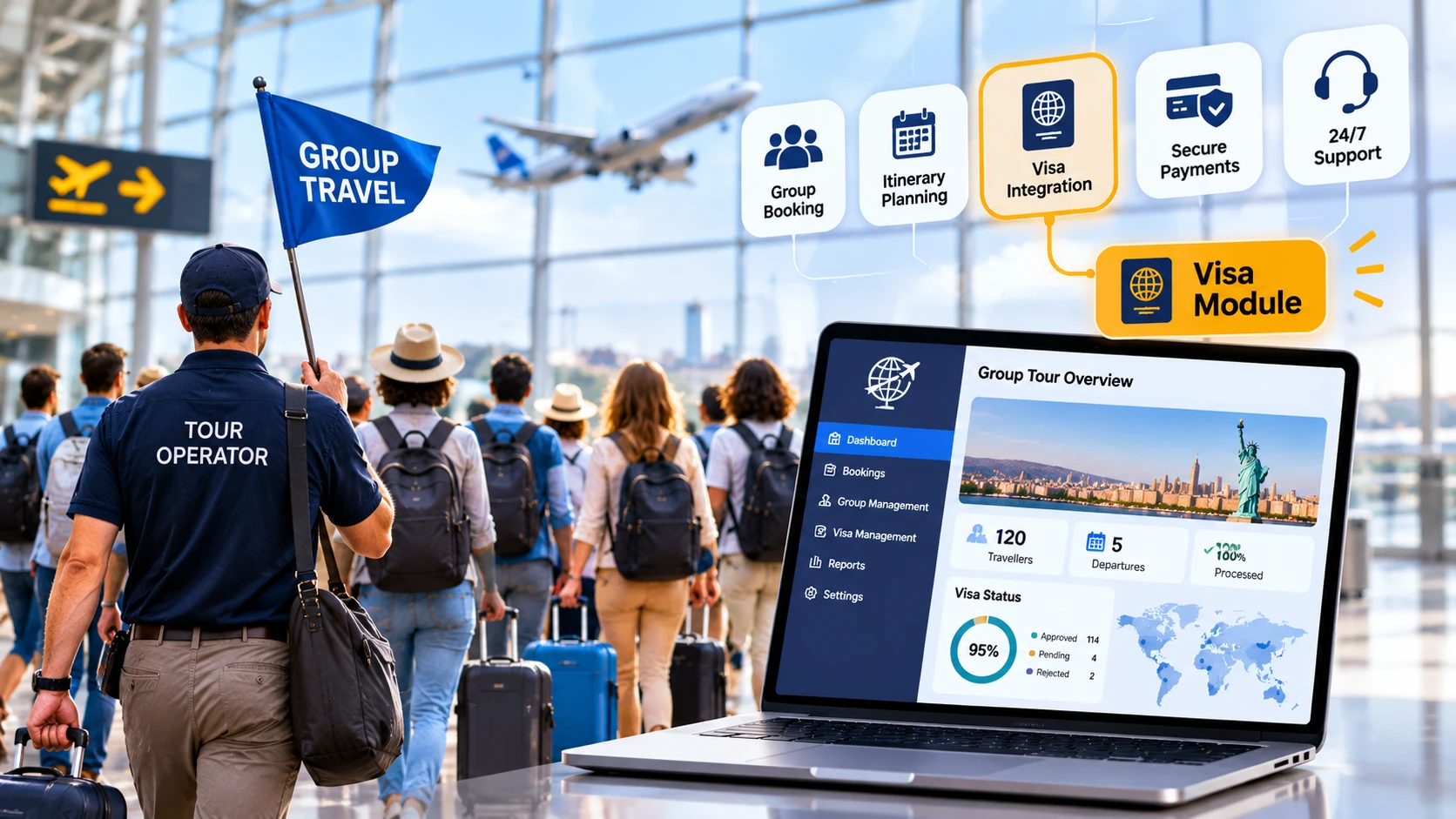
A more efficient way to manage the group visa application is a centralized roster. Instead of collecting each person's documents by email or messaging app, the organizer enters the list of travelers into the system.
Each traveler then gets a personal link to submit their details and required documents directly.
Use a single roster instead of multiple email threads
A structured workflow cuts out manual tracking. Once travelers receive their personal links, they can scan their passports with their phones and upload the required information themselves.
Automatic reminders then go to travelers who haven't finished their submissions, so organizers spend less time following up.
On the organizer side, progress is visible on one screen, a group visa status dashboard. Instead of searching through inboxes and spreadsheets, coordinators can see right away which travelers are ready, which applications are in progress and which documents are still missing.
How large groups are managed
In the YourVisa.ai group workflow, one order can cover up to ten travelers, with shared details entered only once.
For larger groups, you split the travelers into several orders and still see them all on the same management dashboard.
Another key rule is that all travelers in an order must have the same nationality. If your group has more than one nationality, split the travelers accordingly before starting the applications.
For larger travel programs, you can use a visa case tracking dashboard to keep applications, statuses and traveler records in one place.
Protect sensitive travel documents
Passport scans contain sensitive personal information and need to be handled with care.
Rather than having people send them over WhatsApp, from personal email accounts or in a shared group chat, collect them through a secure document portal.
A centralized workflow works better for both the traveler and the organizer. The traveler knows exactly what's needed, reminders go out automatically, and the organizer has a clear view of the whole group's readiness without spending weeks chasing documents.
Budget and Payment: Who Pays for Visas?
Visa and travel authorization costs can be one of the most complicated parts of putting together an international trip, especially when the group has a mix of nationalities and document requirements.
Agreeing on a payment model at the outset avoids confusion later and cuts down on admin.
Three ways to handle visa payments
There are three common ways to handle visa payments. The first is a centralized model, where the organizer pays for all applications and then recovers the cost from travelers as part of the trip budget.
This gives you the most control and is the simplest to track. It just means covering higher costs up front.
The second option is for each traveler to pay directly through a personal payment link. The traveler stays responsible for their own fees, and the organizer can still follow each application through to completion.
The third option is a mixed model where each traveler chooses. Some will want to pay individually; others will prefer the organizer to build the document costs into the overall trip price. This can suit larger groups or groups with a wide mix of people.
Track costs by nationality
A common mistake is to assume every traveler will have the same application costs. In fact, visa fees and required documents can vary a lot by nationality.

For that reason, a group trip planner spreadsheet should list document costs by nationality rather than use a single average for the whole group.
That gives you a much more accurate budget and avoids surprise costs later on.
Understand group pricing opportunities
Some group services offer discounts that grow as more travelers are added to the booking. Depending on how the operator works, those savings can be passed straight to travelers or kept as part of the overall trip margin.
Whichever pricing model you use, transparency is key. Everyone needs to know what's included in the price, what isn't, and when payment is due.
Clear payment policies reduce disputes, improve budget accuracy and make the whole process easier to manage for everyone involved.
The Final Week: What to Check Before Departure
The final week before you leave is the time to stop planning and start verifying. By then, your bookings should be done and your approvals in place.
Travelers should focus on making sure all their documents are on hand and correct. A final check helps you catch small issues before they turn into problems on the day of travel.
Printable pre-departure checklist
- Visa, eVisa, ETA or other approvals downloaded and saved — ☐
- Names on approvals exactly match passport details — ☐
- Arrival cards or pre-arrival registrations completed where required — ☐
- Emergency contact information verified — ☐
- Digital copies of passports stored securely — ☐
- Printed copies of travel documents available — ☐
- Flight, hotel and transfer confirmations accessible — ☐
- Travel insurance documents available — ☐
Each traveler should go through the visa application document checklist before the organizer does the final review.
This makes sure no required document has been missed and that approvals are available both online and offline.
Allow more time for first entry into Europe
Travelers arriving in the Schengen Area should be ready for additional border checks.
The EU Entry/Exit System page states that non-EU travelers may have their biometrics (fingerprints and a facial image) recorded at their first Schengen border crossing. The system has been fully operational since 10 April 2026.
Because these procedures can take longer, travelers should allow extra time at their first point of entry into the Schengen Area.
This matters most for large groups, where border checks can take considerably longer.
Verify every traveler before departure
A good group travel checklist is about confirmed traveler readiness, not assumptions. Make sure every traveler has their passport, approval, supporting documents and contact details in order before departure day.
An hour spent on final verification can prevent a missed flight, a denied boarding and the stress that comes with it once you're on the move.
Special Cases: Minors, Mixed Nationalities and Visits to the US
Most tour groups go through the standard application process, but a few situations need extra planning.
Groups with minors, groups with several nationalities and visitors to the US often have requirements that differ from the rest of the group.
Minors traveling without both parents
When a child travels internationally without one or both parents, a signed parental consent letter may be needed in addition to the child's passport and travel documents.
Requirements vary from country to country, so organizers and families should always check the destination country's official guidance before departure.
Having the right documents helps avoid delays at airport check-in and at border control.
Mixed nationalities require separate reviews
A common mistake is treating the whole group as if everyone has the same citizenship. In reality, travelers holding different passports may face different visa, eVisa, ETA or entry requirements, even on the same itinerary.
To avoid complications, organizers should split travelers by nationality before starting the applications.
That makes it easier to identify the different requirements, manage deadlines and make sure each traveler gets the right travel authorization.
What about traveling to the United States?
Groups coming to the US should know there's no such thing as a group visitor visa that covers every member under one approval. Each visitor is assessed individually and must qualify on their own passport.

Depending on nationality, a traveler may need either an ESTA or a B-2 visitor visa before departure. Approval is decided person by person, even when everyone is on the same group trip.
The key point is to identify special cases early. The sooner you pull minors, mixed-nationality travelers and anyone with specific destination requirements out of the main application stream, the easier it is to keep the whole group on track.
FAQ
1. How do you plan a group trip overseas?
Start six months out. Check passports, nationalities and visa requirements, collect the documents, submit the applications, settle payments and confirm everything before departure.
2. Can an entire group travel on one visa?
Usually not. Most countries require individual travel authorizations, even when people travel together. Each person will generally need their own visa or authorization.
3. How far in advance should a group apply for visas?
Start your document checks around six months before travel and submit visa applications as early as the destination allows.
4. Who should pay for group visas?
Groups can use central payment, individual payment or a mixed model. Pick the one that best suits your group size and budget.
5. What documents does each traveler need?
Most travelers need a valid passport, the right visa (or eVisa/ETA), their booking confirmations and any supporting documents the destination requires.
Get Every Traveler Approved Before the Trip!
The easiest way to avoid delays is to start collecting documents early and track every traveler in one place.
By reviewing passports, nationality requirements, travel authorizations and application status before departure, organizers can catch issues before they affect the itinerary.
Send YourVisa.ai your roster, origin and destination to get a per-traveler quote quickly. For a tour, a school trip, a corporate event or a family group, a centralized workflow cuts manual follow-ups and keeps everyone on schedule through the approval process.