
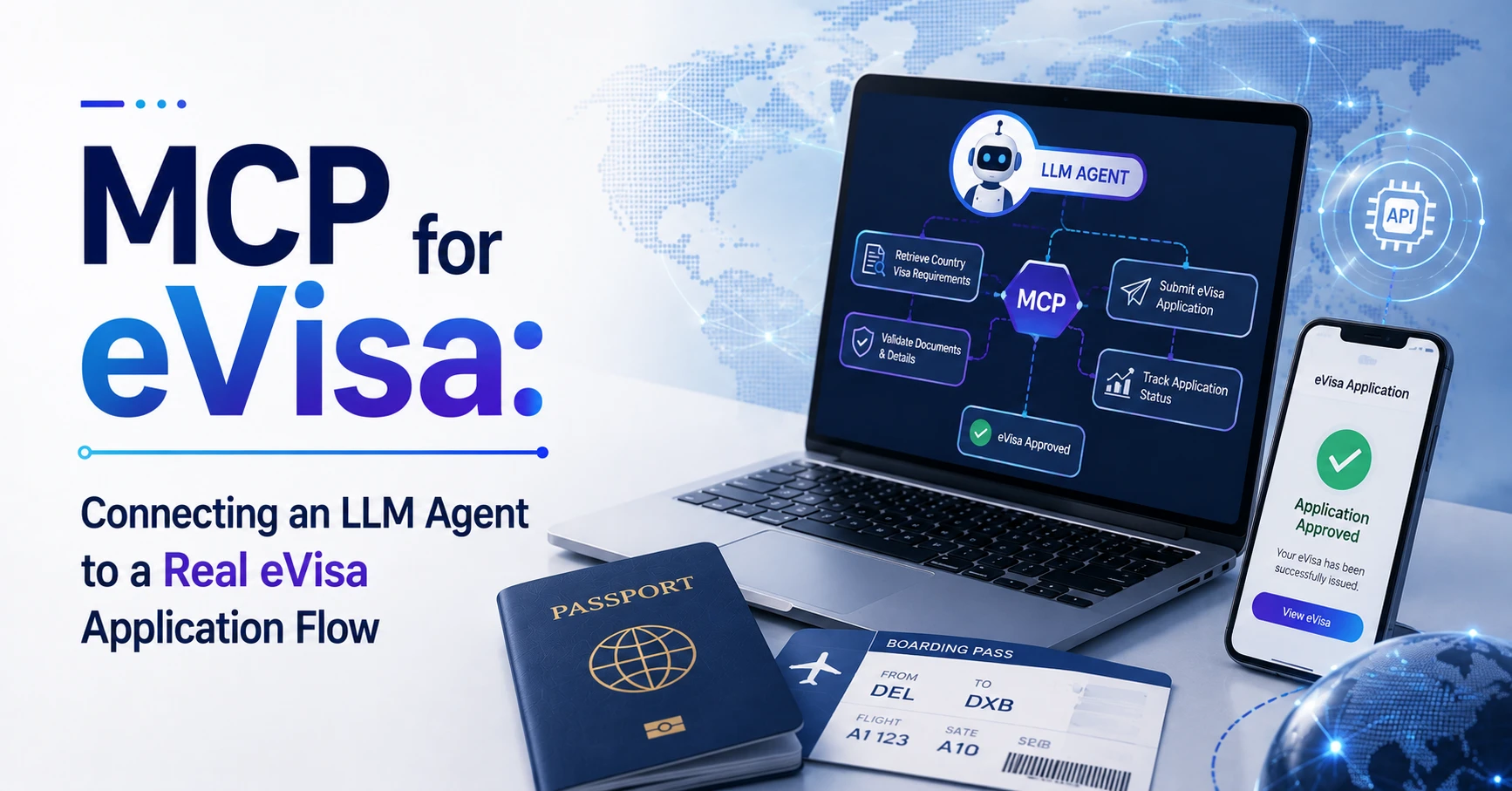
Introduction: MCP as the Standard Front Door for eVisa APIs
Most "AI travel agent" demos still hand the final visa form to a human. The Model Context Protocol (MCP) for eVisa is different. MCP gives an LLM agent a standardized way to call a real API, so it can check requirements and submit a live application, not simulate one.
YourVisa.ai's Travel Visa MCP Integration exposes exactly that connection: one MCP server, one authenticated eVisa application flow, and no custom glue code per agent framework.
MCP is an open standard that lets an LLM agent call external tools. Applied to an eVisa API, that means the agent gets structured, predictable answers instead of scraping a web page.
"MCP for eVisa" specifically means an agent can check visa requirements and submit a real application through a live API connection, with a human still approving the final step.
It is not a replacement for the visa API itself. It is a standardized front door that agent frameworks (Claude, ChatGPT, custom agents) can all plug into the same way.
So, MCP for eVisa processing is the use of the Model Context Protocol to connect AI agents to external visa tools. It lets an LLM-based travel agent query visa requirements and submit an eVisa application through a live API. That is very different from a scripted integration built for one agent framework at a time.
How an MCP Call Actually Works, Step by Step
Before getting into the mechanics, it helps to understand what MCP adds to the developer workflow. MCP is not a new API. It is a standardized way for agents to discover and call existing APIs as tools, as defined in the Model Context Protocol specification.
- Agent Receives Traveler Intent: The process begins when a traveler asks about visa requirements during a booking flow. The agent interprets this intent and prepares to query the MCP server for travel visas.
- Agent Discovers Available Tools: Instead of guessing endpoints, the agent asks the MCP server what it offers. It automatically discovers callable tools such as check-requirements, submit-application and check-status.
- Agent Calls Check-Requirements: The agent passes structured inputs (passport details, destination and travel purpose) into the check-requirements tool. This keeps the query precise and machine-readable.
- MCP Server Executes Underlying API: The MCP server then calls the relevant eVisa API. It returns a standardized result, such as "Vietnam eVisa required for U.S. tourists," without the agent needing any custom integration logic.
- Agent Surfaces Result or Submits Application: The agent shows the requirement to the traveler. With confirmation, it calls submit-application, packaging the documents and payment. Later, it polls check-status until a decision is returned and syncs the outcome back into the booking flow.
A REST endpoint would require bespoke integration code per client. By contrast, an MCP server for travel visas exposes these same five steps through a protocol every compliant agent framework already understands.
This pattern is no longer experimental. Visa Inc. launched its own MCP server in September 2025, a sign that standardized MCP calls are becoming an established integration pattern.
REST vs MCP Integration: Step-by-Step Contrast
| Steps | REST Limitation | MCP Advantage | Outcome |
|---|---|---|---|
| 1. Agent receives traveler intent. | Requires manual mapping of user intent to custom endpoints. | Intent flows naturally into MCP protocol tools. | Faster developer onboarding. |
| 2. Agent discovers available tools. | No discovery; endpoints must be documented and hard-coded. | MCP server advertises callable tools (check-requirements, submit-application, check-status). | Agents auto-adapt without custom code. |
| 3. Agent calls check-requirements. | Each client must build request/response logic for every API. | Standardized input/output schema across MCP servers. | Consistent, reusable workflows. |
| 4. MCP server executes underlying API. | Direct API calls vary by provider, requiring bespoke integration. | MCP abstracts provider APIs into uniform protocol calls. | Reduced integration complexity. |
| 5. Agent surfaces result or submits application. | Developers must write custom submission and polling logic. | MCP exposes submit-application and check-status as standard tools. | Consistent application flow across agents. |
What an Agent Can (and Can't) Do Through MCP for eVisa Today
A dedicated visa management system sits behind the MCP layer. It makes sure every agent call maps to a compliant workflow.
Before getting into specifics, it is worth setting expectations clearly. This section breaks the capabilities into "Can" and "Can't" so developers get a realistic view of what MCP agents can responsibly handle today.
What an Agent Can Do
Through MCP, an agent can already handle several important steps in the eVisa process. First, it can check destination and passport eligibility by calling the check-requirements tool.
Next, it can pull a structured list of required documents, such as a passport photo or scanned information page. The agent can pre-fill an application with traveler details. All of this reduces manual input.
Finally, where the traveler has pre-authorized submission, the agent can call submit-application, which lodges the request with the authorities. These capabilities streamline the workflow and reduce friction for both travelers and platforms.
What an Agent Can't (Yet) Do Responsibly
There are limits to what MCP agents can automate today. They cannot make the final legal submission decision without a human confirmation step, because compliance requires explicit traveler consent.
They cannot guarantee visa approval outcomes; the final decision still rests with the government authorities. Nor can they bypass biometric or in-person requirements. These constraints keep the process secure.
Agent Capabilities Through MCP for eVisa
| Can Do | Can't Do (Yet) | Why |
|---|---|---|
| Check destination and passport eligibility. | Make final legal submission without human confirmation. | Legal compliance requires explicit traveler consent. |
| Pull required documents list and pre-fill application. | Guarantee approval outcomes. | Approval decisions rest with government authorities. |
| Submit application when traveler pre-authorizes. | Bypass biometric or in-person requirements. | Some countries still enforce physical verification. |
A Working Example: An Agent Handling an eVisa Application End to End
Consider a booking assistant helping a U.S. traveler apply for a Vietnam eVisa.
- Intent Captured: The traveler asks, "Do I need a visa for Vietnam?" The agent interprets this intent and prepares to query the MCP server for travel visas.
- MCP Tool Discovery: The agent queries the MCP server and discovers the available tools: check-requirements, submit-application and check-status.
- Requirements Check: The agent calls check-requirements with the traveler's passport details and destination. The MCP server invokes the underlying Vietnam eVisa API and returns a structured result: "Vietnam eVisa required for U.S. tourists."
- Document Request and Submission: The agent prompts the traveler to upload a passport photo and information page. Once provided, the agent packages these documents with the traveler details and, upon confirmation, calls submit-application.
- Status Polling: The agent polls check-status. Once the authorities issue a decision (Vietnam processes eVisas in working days, not hours), the MCP server returns "Approved." The agent syncs this approval into the booking flow, so the traveler receives both flight and visa confirmation.
Illustrative request:
// Agent calls check-requirements
{
  "tool": "check-requirements",
  "input": {
    "passport_country": "US",
    "destination_country": "VN",
    "purpose": "tourism"
  }
}

// MCP server response
{
  "visa_required": true,
  "visa_type": "eVisa",
  "documents": ["passport_photo", "info_page"]
}
This example shows how MCP hides the complexity. Instead of custom REST integrations, agents follow a standardized protocol.
Security and Data Handling: What Doesn't Change
For developers assessing MCP, the most important reassurance is that MCP is a protocol layer, not a new trust boundary. Authentication, encryption and access scoping work exactly as they do for any other API call.
Scoped Access and Audit Logging
Each agent call in MCP is scoped to specific tools. Access is limited to the functions that are exposed, such as checking requirements and submitting the travel application. This prevents overreach and means agents cannot invoke unauthorized actions.
Audit logging is preserved: every agent-initiated action is recorded. This provides traceability for compliance at every level, so developers can trust that MCP adds convenience without weakening accountability.
Sensitive Data Handling Remains Unchanged
The handling of confidential data like passport details does not change simply because an LLM agent is the caller. The same encryption standards, secure transport protocols and storage policies apply.
MCP does not bypass identity checks or weaken safeguards. It standardizes how agents discover and call tools. So MCP streamlines integration but leaves the trust model intact.
An eVisa MCP integration for AI agents acts as a bridge that lets LLM frameworks check visa requirements through one consistent interface.
MCP Tool Call vs. a Traditional Custom API Integration
| Comparison | MCP for eVisa | Custom REST integration |
|---|---|---|
| Setup per agent framework | One MCP server, reused across agents. | Custom code per framework (Claude, ChatGPT, in-house agent, etc.). |
| Discoverability by an LLM | Native: the agent lists available tools automatically. | Requires a manual function-calling schema per integration. |
| Maintenance as agents update | Server maintained once, centrally. | Each integration re-tested per agent SDK change. |
| Best fit | Platforms shipping AI booking/concierge features. | Platforms with one fixed, non-agentic commerce backend. |
Give Your AI Agent a Real Visa API to Call
Curious what a Travel Visa API actually returns? When an agent makes this call, the travel visa API responds with structured outputs.
YourVisa.ai's Travel Visa MCP Integration exposes eVisa checks and submissions as MCP tools your agent framework can call natively.
There is no need to build a custom wrapper for every LLM. That means quicker deployment, lower maintenance and a standardized way to manage visa requirements right inside your booking flows.
FAQs
Is MCP the same thing as a REST API?
No. MCP is a protocol layer that sits on top of your existing API, so AI agents can discover and call it in a standard way. The underlying eVisa API and its logic don't change.
Can an AI agent actually submit an eVisa application on someone's behalf?
Yes. Through an MCP-connected eVisa API, an agent can prepare and submit an application. A responsible implementation keeps a human confirmation step before final submission.
Is MCP secure enough for passport and personal data?
MCP itself doesn't change your authentication or data-handling model. The MCP server sits behind the same authenticated connection as any other API call, and access should still be audited.
Do I need to rebuild my visa integration to support MCP?
No. An MCP server is typically added as a layer in front of an existing eVisa API. A platform that already has visa API access can expose it to agents without re-architecting the underlying integration.