
Travel Visa Management System: The Complete Buyer’s Guide for Agencies and TMCs
Compare travel visa management systems for agencies and TMCs — features, pricing, compliance and ROI, with a build-ready checklist.

Introduction: From Chaos to Control - Modern Travel Visa Management System
Visa applications shouldn’t be managed in scattered spreadsheets, endless email threads, or clunky government portals. However, that is the reality for most agencies & TMCs. The result? Costly visa rejections, refund processing, and wasted hours chasing documents across silos.
A travel visa management system is software that Agencies & TMCs use to collect travel documents. This system validates these documents, submits applications & tracks visa approvals from a single dashboard.
By centralizing every step, visa management software eliminates manual errors. This software can offer your travel teams comprehensive & real-time visibility into traveler readiness.
This guide is written for travel managers, corporate mobility leaders and agency owners. They are tired of inefficiency and compliance risks. By the end of this guide, you will have a clear answer to the most important question - which visa management solution fits your organization’s needs & budget.
So, whether you’re scaling a corporate program or running a high-volume agency, this guide will help you decide - which visa management platform to choose with confidence.
What is a Travel Visa Management System?
Travel visa management software enables agencies, travel management companies (TMCs) & corporates to collect traveler documents, validate them, submit visa applications, and track approvals from one centralized dashboard.
It replaces manual spreadsheets, emails & portals with automation, reducing errors, rejections, and wasted time.
If you are wondering how a visa management system works, the answer is simple: it digitizes every step of the visa process into one streamlined workflow.
How Does Visa Management Software Work?
It ensures faster approvals, fewer errors, and complete visibility for agencies, TMCs, and corporates.
- Document capture – It securely uploads and stores traveler documents in one place.
- Auto-fill from passport scan – It extracts data instantly & reduces manual entry.
- Real-time checks – It validates visas as per applied country-specific rules.
- Application submission – It sends completed forms on time to visa centers.
- Status tracking – It monitors approvals, rejections & pending visa cases.
- Reporting and compliance – It generates dashboards for better visibility. It also ensures policy adherence.
Why are Agencies & TMCs Moving Off Manual Visa Handling Now?
Agencies and travel management companies (TMCs) are under unprecedented pressure. They have to abandon spreadsheets, emails, and portal-based visa workflows. Three forces are converging on them:
- The U.S. visa wait-time crisis – With appointment delays stretching into months, the risk of rejected or incomplete applications is quite high. Each resubmission means lost time, frustrated travelers, & potential refunds (travel.state.gov).
- ETIAS – The Europe entry requirement will add another layer of compliance complexity for agencies. Without automation, keeping up with evolving rules across multiple jurisdictions will be almost impossible.
- Margin pressure from OTA commissions – Online travel agencies continue to squeeze supplier margins, leaving little room for manual inefficiencies. Every wasted hour on visa processing erodes profitability further.
The fix is clear - automation. By adopting a TMC visa compliance platform that automates travel visa compliance, TMCs can reduce resubmission risk. They can stay ahead of new regulatory requirements. They can also protect margins in a competitive market.
So, moving off manual handling isn’t just about efficiency—it’s about survival in a landscape where compliance, speed, and cost control define success.
Core Features to Look for in Visa Management Software
When evaluating a travel visa management system, agencies and TMCs should focus on features that directly reduce errors.
They must look for functionalities that improve compliance and streamline traveler readiness. Below are the core capabilities that define a modern Visa Management solution.
Passport Scan & Auto-fill.
Accurate data entry is extremely critical in the processing of visa applications. Passport scanning with an auto‑fill feature reduces manual mistakes. It quickly and precisely extracts traveler details. This functionality ensures faster data processing. It also reduces visa rejections.
Real-time Visa/ETA Requirement Checks.
Rules vary by nationality and destination. They change frequently & can be complex to deal with. Real-time requirement checks validate applications against current regulations before submission. This minimizes costly resubmissions for both agencies & travelers.
Document Intelligence.
Smart document management goes a step ahead of storage. Quality checks ensure files meet all embassy standards. Missing-item detection alerts the team before visa submissions. Risk flags highlight involved visa & travel challenges. All this prevents incomplete applications from reaching out to embassies.
Centralized Case Dashboard & Status Tracking.
A single dashboard consolidates every traveler’s case. It showcases submission progress, pending approvals, & alerts. Status tracking provides transparency for both agencies & travelers. Visa tracking software for TMCs reduces manual follow-up work.
Reporting & Analytics.
Visa management software should provide clear insights into approval times, volume trends & revenue impact. Analytics help managers identify bottlenecks in the process. They also allow teams to forecast demand more accurately. With these insights, operations can be optimized for efficiency.
Security & Compliance.
Handling sensitive traveler data requires strong safeguards. Encryption and PCI‑DSS compliance are essential. These data protections keep agencies and travelers safe. They even help agencies in avoiding regulatory risks.
By combining these capabilities, agencies can streamline operations. They can also enhance travelers’ confidence levels.
Some platforms even include an AI visa assistant that answers traveler questions. This offers travelers instant clarity on requirements.
So, with the right visa management software, agencies can automate compliance and reduce risk. They can scale efficiently in today’s competitive travel landscape.
Deployment Models: Cloud Vs On-Prem, White-Label vs API.
Choosing the right deployment models for a travel visa management system is critical. Agencies and TMCs can balance efficiency, compliance, and customer experience with the right choice.
Cloud visa management system.
A cloud visa management system offers long-term business scalability. It helps lower upfront costs for agencies when matched to on‑premises system installations.
Agencies can benefit from automatic compliance updates & have real‑time data synchronization. Cloud platforms offer remote access. This makes it easier for distributed teams to collaborate on traveler cases.
In contrast, on-prem systems need heavy infrastructure. They require investments and ongoing maintenance. They adapt slowly to regulatory changes. For organizations managing high volumes of visas – the cloud model ensures higher agility levels.
White-label Portal vs Embeddable Widget vs API.
| Model: | How It Works. | Best For. | Key Advantage. |
|---|---|---|---|
| White-label portal: | Full visa management interface branded as the agency’s own. | Agencies and TMCs needing turnkey solutions with strong branding control. | Seamless customer experience with minimal development effort. |
| Embeddable widget: | Lightweight module integrated into existing booking flows. | OTAs seeking quick integration without building a portal. | Fast deployment inside existing platforms. |
| API: | Backend integration of visa workflows into custom systems, CRMs, or booking engines. | Tech-savvy firms or platforms needing bespoke workflows and monetization. | Maximum flexibility, enabling agencies to design unique processes and revenue streams. |
So, with the right setup, agencies can turn each visa into a commission. They can embed ancillary revenue streams directly into their booking ecosystem.
By weighing cloud vs on‑prem and portal vs API, agencies can align their travel visa management system deployment. With proper setup, agencies can meet their operational needs and set revenue goals.
Visa Management System Pricing – How Vendors Charge
When agencies, TMCs, and corporates evaluate travel visa management system pricing, they’re really asking how vendors structure costs. And what the total investment looks like.
As visa processing is transactional, vendors charge for it according to its usage pattern. The pricing models balance both volume & revenue opportunities. Let’s break down the involved pricing approaches:
Per-application Pricing.
This is the simplest model, where the traveler pays a fixed fee for each visa application that is processed. It is easy to forecast costs even when volumes are low or irregular. Smaller agencies often prefer this model, since they can avoid large upfront payment commitments.
For high‑volume operators, costs may escalate quickly. However, vendors still offer tiered discounts. These discounts apply once their monthly application thresholds are crossed.
Subscription Pricing.
This model offers a high level of stability. Agencies have to pay a monthly or annual fee. This fee is tiered by user count. This approach suits organizations with steady demand.
It simplifies budgeting & ensures access to bundled features like reporting, compliance updates, and support.
The model encourages long‑term adoption. Agencies can plan around predictable expenses. For larger TMCs, subscriptions even include enterprise-grade SLAs.
Revenue-share / Commission Models.
Some of the vendors often align their pricing with agency revenue. They take a percentage of each visa transaction. This reduces upfront costs. It also allows agencies to directly monetize visa services.
This turns compliance into a revenue line, with ancillary income embedded directly into the booking ecosystem.
This model is attractive for agencies that want to expand services without heavy investment. However, it requires careful margin management.
Setup & Integration Timelines.
Beyond pricing structure, integration speed is critical. Vendors offer SDKs or APIs to connect visa workflows into booking platforms, CRMs, or portals. Integration timelines range from 5 to 15 days. They rely on the involved integration complexity levels.
White‑label portals are much quicker to deploy. In contrast, full API integrations require more technical effort. However, they deliver maximum flexibility levels.
So, agencies must include precise integration timelines in their set plans. As delays during setup can significantly impact traveler readiness.
Choosing the Right Pricing Model.
The best pricing structure depends on your agency’s size. It also relies on the traveler volume & your business growth strategy. Per‑application fees suit smaller firms with volatile demands.
The subscription model provides predictability for steady operators. In contrast, the commission model aligns costs with the overall revenue.
Ultimately, visa management system pricing is about more than numbers. It is about aligning cost structures with operational efficiency, compliance & profitability.
By understanding these options, agencies can select a model that reduces risk. It also supports long-term business scalability.
How Does a Visa Management System Cut Rejection Rates?
Visa rejections are one of the most frustrating pain points for agencies, TMCs, and corporates. They lead to wasted time, dissatisfied travelers, and lost revenue.
A modern travel visa management system automates visa compliance and addresses rejection rate challenges. The system embeds validation, standardization & compliance into all processing stages. By using this approach, the system turns rejection risk into a predictable, manageable process.
Validation Before Submission.
The first step is application validation. So, rather than relying on manual checks, the system automatically verifies applications as per current regulations.
This includes checking nationality-specific details, destination rules, and document standards before submission.
By catching errors early, agencies avoid costly resubmissions and protect traveler confidence. Validation ensures that every application meets embassy criteria at the point of submission. This reduces the probability of visa application rejection.
Standardized Checklists.
Human error is a major cause of incomplete applications. Visa management platforms solve this with standardized checklists. These checklists are tailored to each visa type. They guide staff & travelers through required documents, forms, and supporting evidence.
Standardization ensures consistency across high‑volume operations. This makes it easier for agencies to scale without sacrificing accuracy. For corporates & group organizers, checklists provide full transparency for every traveler.
Audit Trails & Compliance.
Compliance is about meeting embassy requirements & accountability. Visa management systems log every action taken. This leads to a transparent audit trail.
This strengthens compliance with international standards and provides agencies with defensible records in case of disputes.
Modern platforms cross-check every application against official government and border-control requirements before it is submitted.
Bridge to Compliance Automation.
Validation, checklists & audit trails form the base of compliance. Together, they enable agencies to automate visa compliance and also cut rejections. They help in moving beyond manual processes to scalable and error‑free workflows.
This is the natural bridge to the compliance cluster, where automation reduces rejection rates and also enhances traveler trust with operational efficiency.
Why Cutting Rejection Rates Matters?
For TMCs, fewer rejections lead to seamless travel programs. For Agencies, it translates into customer satisfaction. Also, they get more repeat business. For corporates, fewer rejections ensure travel‑ready teams. Group organizers can truly benefit from a reduction in their travel program cancellations.
By embedding validation, standardized checklists & audit trails, a visa management system reduces rejection rates. It also transforms compliance into a competitive benefit.
Agencies gain confidence that every application is complete, compliant & ready for approval. This safeguards traveler experience and leads to higher agency margins.
Buying Checklist – How to Choose the Best Travel Visa Management System
Selecting the best travel visa management system requires a well-structured evaluation process. Agencies, TMCs, and corporates must weigh operational needs, compliance requirements, and growth strategies against what vendors offer.
Below is a scannable checklist. It is well-designed to help decision‑makers compare visa management solutions.
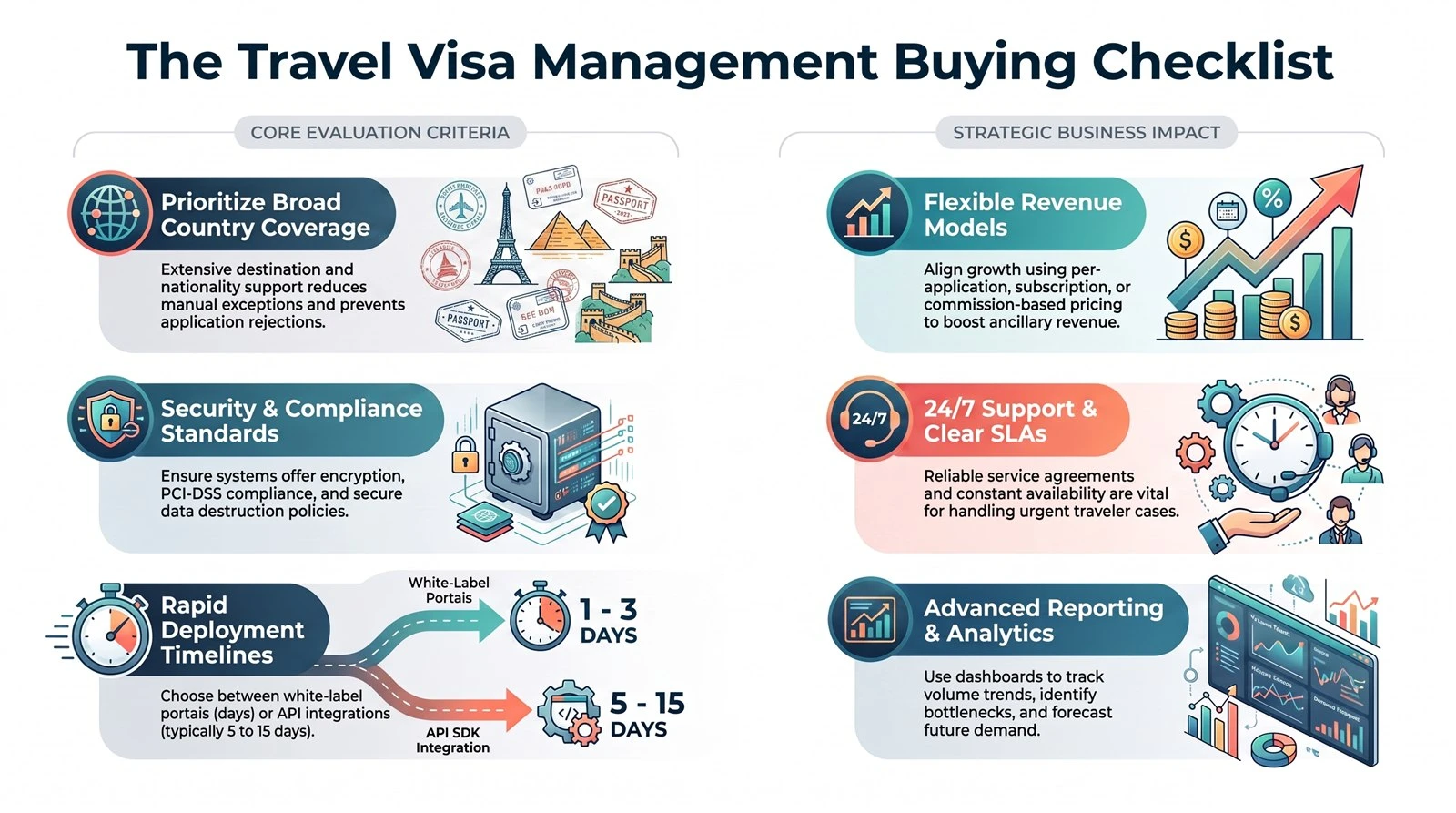
Country Coverage.
The first step is ensuring the system supports the destinations & nationalities you serve most. Broad coverage reduces manual exceptions and ensures scalability. Without adequate coverage, agencies risk gaps that lead to delays or rejections.
Integration Time.
Evaluate how quickly the travel visa management system can be deployed. White‑label portals may launch in days. However, APIs typically take 5 to 15 days for SDK integration.
Quick system onboarding minimizes the probable level of disruptions. It enables agencies to embed visa services that too directly into their current booking flow swiftly.
Security & Compliance.
Handling sensitive traveler data requires a stronger level of safeguards. Look for encryption, PCI‑DSS compliance & secure data destruction policies. These aspects protect both agencies & travelers from possible breaches.
Revenue Model.
Understand whether your pricing model should be per‑application, subscription, or commission‑based. The right model will quickly align with your current margins & overall growth strategy.
Commission structures allow agencies to turn each visa into a commission. They can embed ancillary revenue streams directly into their ecosystem.
Support & SLA.
Reliable support is vital for urgent traveler cases. Look for a vendor that guarantees fast response times.
Strong SLAs ensure dependable service during peak seasons. 24/7 support and clear SLAs are essential.
Reporting & Analytics.
Choose a system with advanced dashboards. Agencies should be able to track volume trends and revenue impact easily.
Analytics must help travel managers spot bottlenecks & forecast demand. This visibility is key to agencies & TMCs, who want to scale business operations.
Product Roadmap.
Ask vendors about their upcoming software features. A forward‑looking product roadmap keeps your investment relevant.
Regulations & traveler needs evolve constantly. So, systems that innovate continuously deliver long‑term value.
Following this checklist builds confidence in decision‑making. Agencies can identify the best travel visa management system. The right choice ensures growth.
Buying Framework for Travel Platforms:
- Broad country coverage reduces exceptions.
- Rapid integration keeps your operations seamless.
- Strong compliance safeguards travelers’ data.
- Streamlined workflows improve your efficiency levels.
- Agencies unlock new revenue opportunities.
- Automation blends with your branding flexibility.
- Scalable solutions reduce possible risks.
Who it’s for – TMCs, Agencies, Corporates and Group Travel
A modern visa management system is not a one‑size‑fits‑all tool. It is designed to serve different segments of the travel industry, each with unique challenges and priorities.
By tailoring features to the needs of travel management companies, agencies, corporates & group organizers, the platform ensures efficiency, compliance, and scalability across diverse use cases.
Travel Management Companies (TMCs).
For TMCs, the ability to manage high‑volume applications across multiple destinations is extremely critical. Visa software for travel management companies offers access to centralized dashboards.
They enable automated compliance checks & integrations with booking flows. This reduces manual effort. It ensures that travelers are always prepared with the needed documentation.
TMCs benefit from real‑time visibility into traveler readiness. This enables them to deliver a seamless experience to their corporate clientele.
TMC visa automation also helps manage complex regulatory environments. With features like passport scanning, auto‑fill & real‑time requirement validation, they can minimize rejection rates and protect margins.
For TMCs competing in a tight market, a precise corporate visa management software for TMCs becomes a differentiator—offering both operational efficiency and client trust.
Travel Agencies.
Agencies operate in competitive environments where customer experience & revenue diversification matter a lot. A visa management system for travel agencies allows them to embed visa services directly into their business offerings.
It doesn’t matter whether it is through white‑label portals, embeddable widgets, or APIs. This flexibility ensures agencies choose the deployment model that fits their business strategy.
For example: an agency can integrate AI booking assistants that manage visas into its digital ecosystem. This integration offers travelers instant clarity on their requirements. It improves customer satisfaction. It even creates new revenue streams.
So, agencies can monetize visa services by charging per application or earning commissions, turning compliance into profits.
Corporates.
Corporates face a different challenge. They need to ensure entire teams are travel‑ready for business trips, conferences, or relocations. Agency visa tools provide HR & mobility managers with centralized dashboards, compliance alerts & reporting.
Instead of tracking applications manually, corporates can keep a whole team travel‑ready with real‑time visibility into approvals and pending cases.
This reduces the risk of last‑minute disruptions and ensures compliance with international regulations. For corporates managing global mobility programs, the system becomes a strategic asset—helping them safeguard productivity and employee satisfaction.
Group Travel Organizers.
Group travel needs careful coordination. Sports teams, academic programs & conferences involve hundreds of travelers.
Managing them requires streamlined processes for smooth trips. A bulk visa processing platform can simplify these processes. It can consolidate travel applications, documents & approvals. Organizers can manage submissions collectively.
A group visa application software can track progress. It can ensure compliance without chasing down every traveler. This is quite valuable for travel organizations that run recurring group trips. By automating compliance checks, they can reduce overheads.
Visa Management System – Audience Snapshot:
| Segment: | Needs | Key Features | Benefits |
|---|---|---|---|
| TMCs | High-volume apps. | Dashboards, compliance checks & auto-fill. | Less manual work, fewer rejections & client trust. |
| Agencies | Compete & grow revenue. | White-label, widgets & APIs. | Flexible models, instant clarity & new streams. |
| Corporates | Team travel-readiness. | Dashboards, alerts & reporting. | No last-minute issues, compliance & productivity. |
| Group Organizers | Large group trips. | Bulk processing & collective workflow. | Easy coordination, lower overhead & reliable trips. |
Why Segmentation Matters?
A visa management system segments features for TMCs, agencies, corporates & group travel. This ensures relevance across the complete travel ecosystem. Adaptability makes the platform more valuable.
The platform supports effective scaling of operations. Compliance safeguards are built in. Agencies can monetize services with full confidence. Fewer rejections and less manual work follow. Stronger traveler trust resonates across the travel industry.
Frequently Asked Questions - Travel Visa Management Systems
What is a visa management system?
How much does a travel visa management system cost?
Is a “visa management platform” different from “visa management software”?
Can a visa management solution integrate with a booking flow?
How does a visa management system reduce rejections?
Is travelers’ passport data completely secure?
Moving Forward
So, are you ready to cut rejections, manual work, and unlock new revenue? A modern travel visa management system helps agencies, TMCs, and corporates cut rejection rates. This further eliminates manual work and unlocks new revenue streams.
This system can automate compliance checks for smoother workflows. Streamline document management to cut errors. Embed visa services directly into booking flows.
So, you can gain business efficiency & build traveler confidence through the visa management solution.
Action matters—see the platform live, reduce your business risks, and grow margins. With a visa management system, you can deliver fewer rejections, smoother workflows, and drive new opportunities starting today!