How to Automate Visa Applications: A Strategic Guide for Travel Agents
Transform your visa processing workflow with AI-powered automation. Eliminate manual data entry, reduce rejections, and scale your agency without adding headcount.
Table of Contents1. What Is Visa Application Automation and Why Does It Matter?
Visa application automation is the use of AI-driven technology to manage, process, and submit travel visa documentation without manual intervention — allowing travel agencies to handle more client volume, eliminate costly errors, and achieve faster approvals while reducing operational overhead.
For decades, visa processing has been one of the most friction-heavy workflows in the travel industry. Travel agents routinely spend hours per client navigating dense government portals, transcribing passport data, chasing missing documents, and re-submitting rejected applications. The core problem is not complexity — it is manually repeating the same compliance-driven steps across hundreds of clients with zero room for error.
YourVisa.ai eliminates this bottleneck. By combining generative AI, computer vision, and real-time regulatory monitoring, the platform turns a multi-hour manual workflow into a process that completes in minutes — with higher accuracy and zero added headcount.
Why This Matters Operationally: High rejection rates cost agencies rework time and client trust. Every rejected application means a re-submission cycle that can delay a trip and erode a long-term client relationship. Automation removes the root cause: human error in form completion and document assembly.
2. The Biggest Pain Points Travel Agents Face With Visa Processing
Before examining how automation solves the problem, it is important to name exactly where the operational drag comes from. Travel agents managing visa workloads consistently identify four failure points:
2.1 Dense, Inconsistent Government Forms
Government visa applications are not designed with the applicant in mind. Field labels are ambiguous, required attachments vary without clear explanation, and the same traveler data must be re-entered across multiple government portals in incompatible formats. A single typo — a transposed passport number, a misformatted date — can trigger an automatic rejection.
2.2 High Rejection Rates Due to Documentation Gaps
The consequences of rejection are not just a minor inconvenience. Agencies absorb the time cost of diagnosing the rejection reason, correcting the submission, and managing the client relationship throughout the delay. For agencies processing high volumes of applications, rejection rates are a direct margin killer.
2.3 Biometric and Photo Compliance Failures
Many visa rejections stem from non-compliant passport photos — incorrect dimensions, disqualifying backgrounds, poor lighting, or head-positioning errors. Government photo standards differ by country and are updated periodically, making manual compliance difficult to guarantee.
2.4 Near-Term Passport Expiry Going Unnoticed
Agents processing applications for dozens of travelers simultaneously frequently miss expiry dates that will cause rejections. Most countries require a minimum of six months of passport validity beyond the intended travel dates. Missing this check results in wasted application fees and urgent passport renewal scrambles.
The Hidden Cost of Manual Processing: These four failure points combine to create a compounding operational burden. Agencies that have not automated their visa workflows are effectively paying an invisible tax — in time, in rework, and in client attrition — that their competitors using automation have already eliminated.
3. How AI Automation Simplifies Government Form Completion
The foundation of YourVisa.ai's automation capability is its ability to translate complex governmental requirements into simple, actionable prompts for the traveler. Instead of presenting a client with a 12-page government form, the platform asks plain-language questions and maps the answers directly to the correct fields on the official documentation.
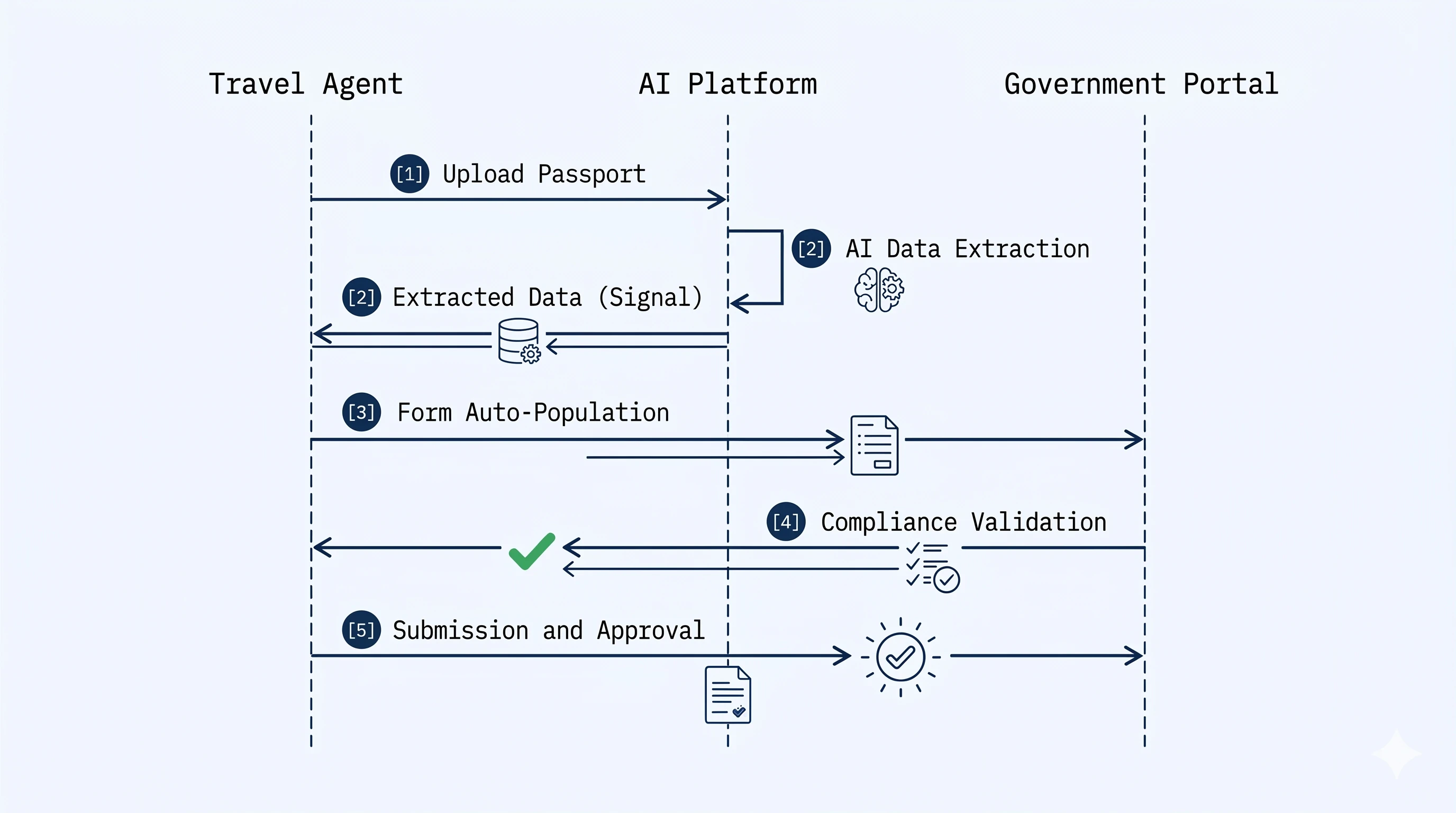
Here is how that works in practice:
- Smart Autofill: The platform reads a traveler's passport via computer vision and auto-populates all relevant data fields — name, passport number, nationality, date of birth, expiry date — across every applicable form, eliminating the need for manual transcription.
- Plain-Language Prompts: Complex government requirements become clear, simple instructions that travelers can action immediately without interpretation — for example, "Upload hotel booking confirmation" instead of bureaucratic government language.
- Validation at Point of Entry: The system flags errors and missing fields before submission — not after rejection — dramatically reducing the rework cycle that consumes agent time.
- Dynamic Form Updates: When government forms change, the platform updates its mapping automatically, so agents are never submitting against an outdated form version.
4. Computer Vision: Passport Parsing and Photo Standardization
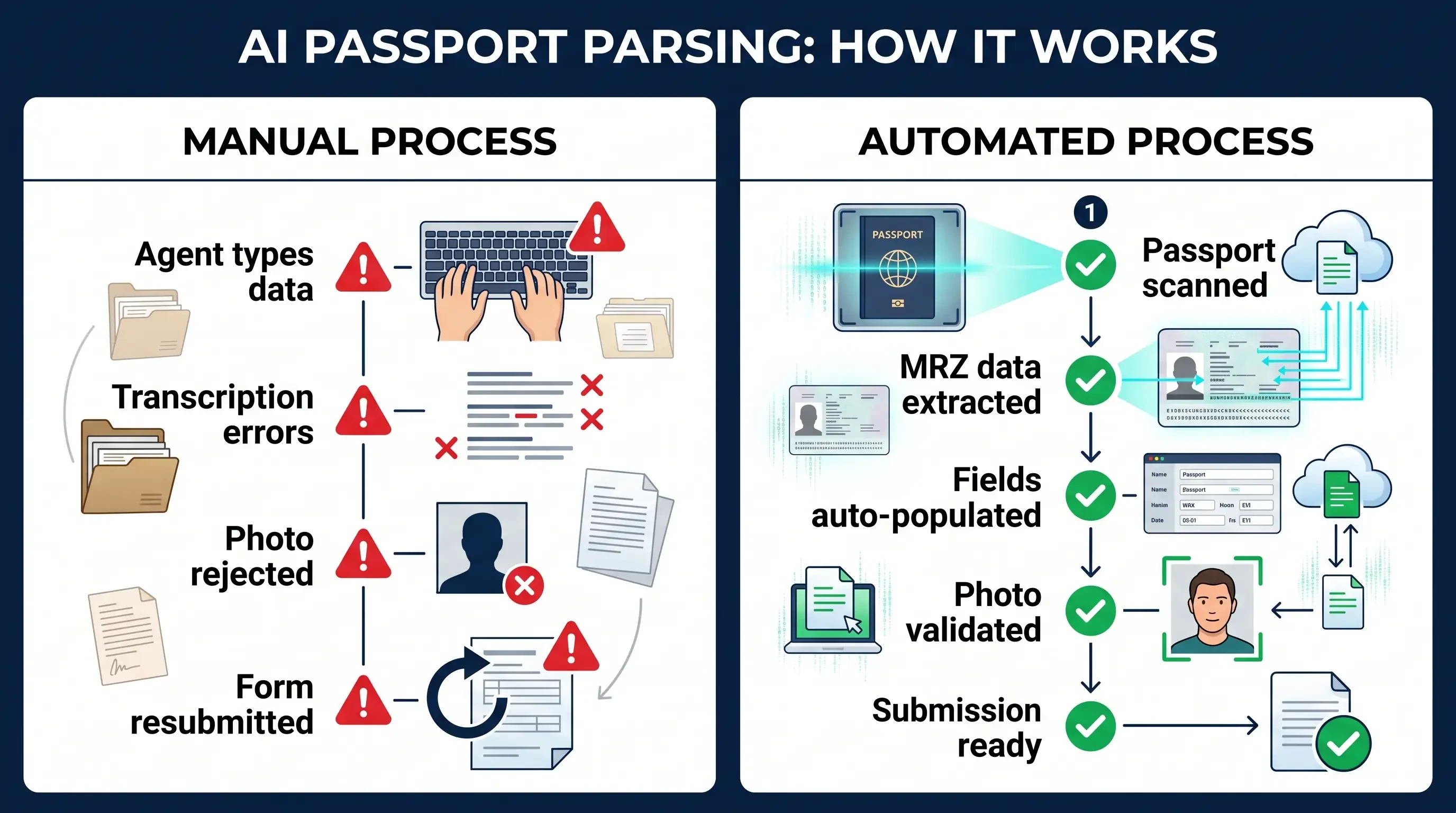
Computer vision is the component of YourVisa.ai's technology stack that eliminates two of the most common manual bottlenecks: passport data transcription and biometric photo compliance.
4.1 Passport Document Parsing
When a traveler uploads a photo or scan of their passport, the platform's computer vision engine reads the Machine Readable Zone (MRZ) and extracts all relevant fields with accuracy that manual data entry cannot match. The parsed data is then automatically mapped to the appropriate form fields across all required government applications.
4.2 Biometric Passport Photo Standardization
Photo rejection is one of the most preventable causes of visa application failure. YourVisa.ai's system analyzes uploaded traveler photos against the specific biometric requirements of the destination country:
- Pixel dimensions and aspect ratio
- Background color compliance
- Face positioning and centering
- Lighting uniformity and shadow detection
- Eye openness verification
4.3 Near-Term Expiry Detection
Every passport scan is automatically checked against the destination country's minimum validity requirement. If a traveler's passport will expire within the required window — typically six months beyond the return travel date — the system flags it immediately at upload, before any application fees are paid.
5. Real-Time Compliance Monitoring Across 195+ Countries
One of the most underappreciated risks in visa processing is regulatory change. Keeping pace with evolving travel and visa requirements across every destination is operationally impossible when done manually. Governments update documentation checklists, fee structures, and form versions with minimal advance notice — and an agency caught submitting against outdated requirements faces mass rejections and client disruption.
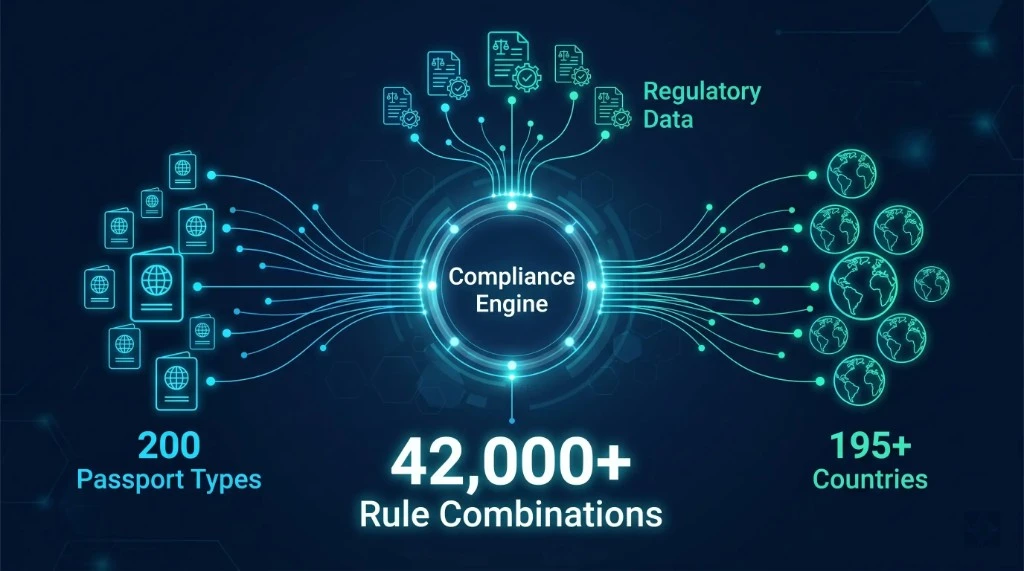
YourVisa.ai monitors travel and visa requirements across more than 195 countries in real time. When a government updates its visa policy, the platform's compliance engine updates automatically, ensuring every application submitted reflects current rules — not last month's version.
What this means for a travel agency operationally:
- No manual compliance updates: Agents do not need to track regulatory changes country by country. The platform absorbs that responsibility.
- Consistent accuracy at scale: Whether an agency is processing 10 applications or 10,000, the compliance layer applies the same current standards to every submission.
- Reduced liability exposure: Agencies using a manually maintained compliance process carry the risk of outdated information. Automated monitoring eliminates that exposure.
Operational Reality: Real-time compliance monitoring is not just a feature — it is a risk management tool. For agencies operating at volume, a single batch of applications submitted against a newly changed government requirement can result in mass rejections and significant client disruption.
6. eVisa, ETA, and ETIAS Integration
The global shift toward digital authorization systems — electronic visas (eVisas), Electronic Travel Authorizations (ETAs), and Europe's upcoming European Travel Information and Authorization System (ETIAS) — is fundamentally changing what travel agents need to manage. Travel eVisa, ETA, and ETIAS integration is no longer optional for agencies serving international travelers; it is a core operational requirement.
6.1 eVisa (Electronic Visa)
An eVisa is a fully digital visa issued by a government and stored electronically — no physical sticker or stamp required. Applicants apply online, upload documents, pay fees, and receive approval via email. Countries such as India, Turkey, Australia, and Kenya have adopted eVisa systems. YourVisa.ai's platform is built to handle eVisa applications end to end, including document parsing, form submission, and status tracking.
6.2 ETA (Electronic Travel Authorization)
An ETA is a pre-entry authorization system used by countries like Canada, Australia, and the United Kingdom. Unlike a visa, an ETA does not require extensive documentation — but it does require accurate applicant data and timely submission. Errors in ETA applications can result in denial at the border, making automated accuracy critical.
6.3 ETIAS (European Travel Information and Authorization System)
ETIAS is the European Union's forthcoming pre-travel authorization requirement for visa-exempt travelers entering the Schengen Area. When live, it will affect travelers from over 60 countries. Travel eVisa, ETA, and ETIAS integration within a single platform — like YourVisa.ai — means agencies will not need separate workflows for each authorization type. One platform handles all three, monitored in real time as requirements evolve.
Preparation Matters Now: Agencies that build eVisa, ETA, and ETIAS processing into their workflow before ETIAS goes live will be positioned to absorb new Schengen-bound volume without operational disruption. Those still managing these applications manually will face a significant bottleneck.
7. Immigration and Travel Visa API
An Immigration and Travel Visa API is a programmatic interface that allows software systems to query, retrieve, and submit visa-related data — including eligibility rules, required documentation, fee schedules, and application status — without requiring a human to manually navigate government portals or third-party databases.
For travel agencies, an Immigration and Travel Visa API is the infrastructure layer that makes automation possible at scale. Rather than having agents log into individual government websites for each country, the API connects the agency's workflow directly to a unified data source that reflects current immigration rules and processing status across all supported destinations.
YourVisa.ai's API integration layer covers:
- Real-time eligibility checking: Determine visa requirements for any traveler-destination-nationality combination instantly.
- Document requirement retrieval: Pull the current, validated document checklist for any destination automatically.
- Application status tracking: Monitor submission status across all active applications from a single dashboard, without manually checking individual government portals.
- Fee and processing time data: Surface accurate, current fee structures and processing timelines to clients at the point of booking.
7.1 Travel Visa API on GitHub vs. YourVisa.ai
A common starting point for technically minded travel agencies is searching for a travel visa API on GitHub — open-source libraries and datasets that provide structured visa requirement information. These repositories do exist, and some offer useful reference data. However, they come with significant operational limitations that make them unsuitable as a production solution for a travel agency.
| Open-Source GitHub API | YourVisa.ai |
|---|---|
| Static datasets with infrequent updates | Real-time regulatory monitoring across 195+ countries |
| Data only — no workflow automation | End-to-end document automation and form completion |
| No photo validation capability | Biometric photo validation against country-specific standards |
| No uptime guarantee or SLA | Production-grade reliability with support structure |
| Requires internal engineering resources | Ready-to-use platform with no engineering overhead |
| No compliance accountability | 99% approval success rate with audit trail |
Related Reading
For a deep-dive into the technical architecture of visa API integration — including RESTful patterns, OAuth 2.0 authentication, and reliability engineering — see our Travel Visa API Integration Guide for OTAs.
8. Performance: 15× Faster Processing and 99% Approval Rate
8.1 How 15× Faster Processing Is Achieved
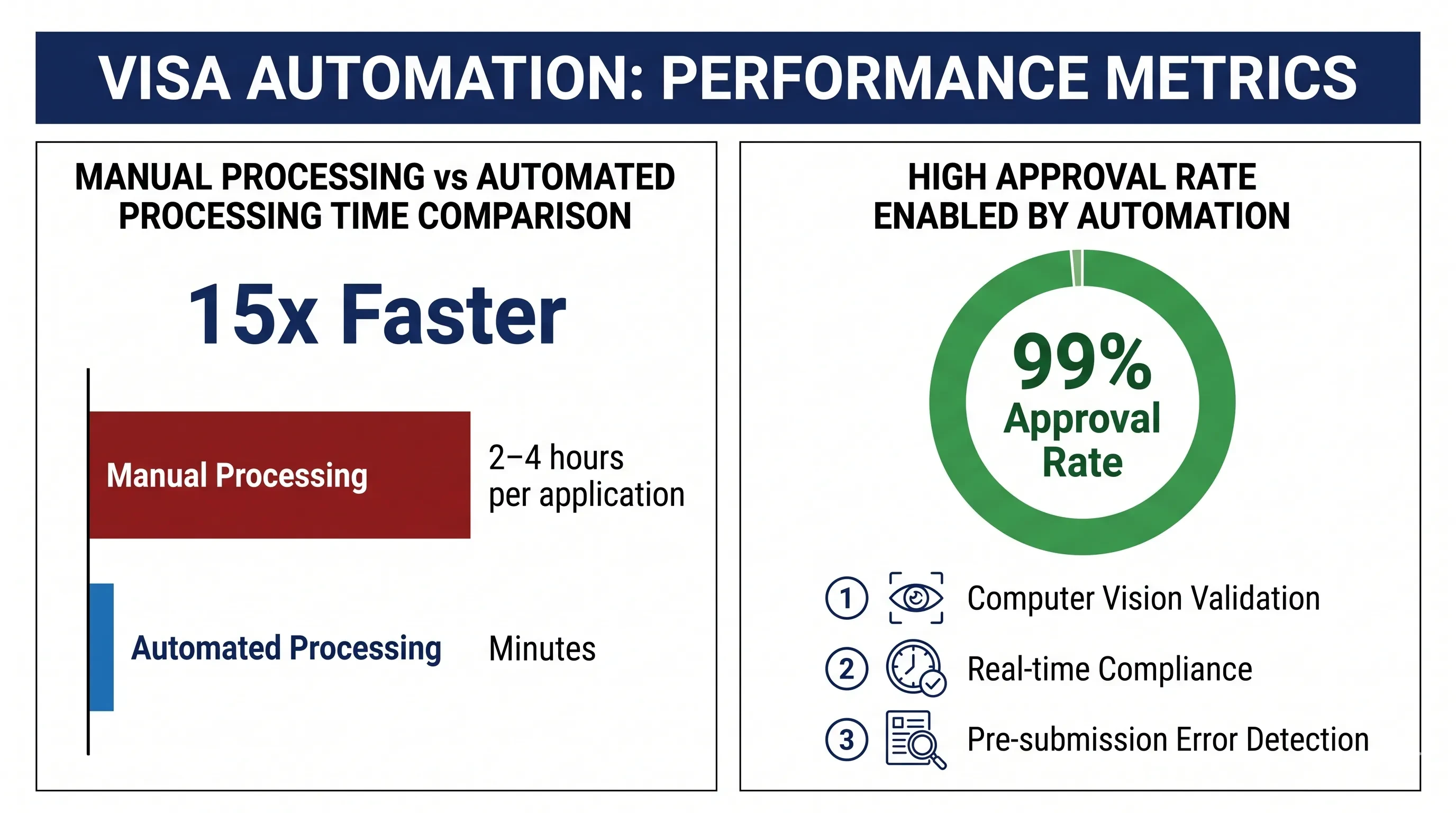
The 15× faster processing speed YourVisa.ai delivers reflects the actual time compression that occurs when manual steps are replaced with automated ones across the entire visa workflow.
Consider the time investment in a traditional agency workflow for a single visa application:
- Collecting and verifying traveler documents: 15–30 minutes
- Manually transcribing passport data into government forms: 20–45 minutes
- Reviewing and formatting biometric photos: 10–20 minutes
- Checking compliance requirements for the destination country: 15–30 minutes
- Submitting and confirming the application: 10–20 minutes
- Correcting errors after a rejection (if applicable): 60–120 minutes
In a manual workflow, a single application can consume two to four hours of agent time. On YourVisa.ai, the same workflow — from document upload to submission-ready application — takes minutes. Multiplied across an agency's full client volume, that time compression directly translates to margin expansion without adding administrative headcount.
8.2 How 99% Approval Rate Impacts Revenue
A 99% approval success rate is the downstream result of eliminating the error sources that cause rejections in the first place. When passport data is parsed by computer vision, biometric photos are validated before submission, and compliance rules are applied from a real-time regulatory database — rejections become the exception rather than the standard operating condition.
- Direct Cost Reduction: Rejected applications require rework. Rework consumes agent time. Eliminating rework through a higher approval rate frees that time to be redeployed toward new client acquisition and service delivery.
- Client Retention and Lifetime Value: A visa rejection disrupts a traveler's trip planning and creates anxiety. Agencies that consistently deliver approved visas without incident build a level of client trust that is difficult for competitors to displace.
- Volume Capacity Without Headcount Expansion: Agencies can scale their throughput without scaling their administrative headcount. By replacing the time-intensive manual components of visa processing with automated workflows, an existing team can handle significantly higher client volume.
9. Which Travel Agencies Benefit Most From Visa Automation?
Visa application automation delivers measurable operational benefit across agency types, but the return on investment is most pronounced in specific contexts:
High-Volume Leisure Agencies
Agencies managing large cohorts of leisure travelers — particularly to destinations with complex visa requirements such as India, China, Russia, and the Schengen Area — face the highest per-client processing burden. Automation reduces that burden to near-zero per application.
Corporate Travel Management Companies
Corporate travel managers handling frequent international business travelers need speed and reliability above all else. The 15× processing speed advantage is particularly valuable in time-sensitive corporate travel contexts where a delayed visa can cost a client a missed business opportunity.
Tour Operators and Group Travel Coordinators
Managing visa applications for a group of 20, 50, or 200 travelers manually is operationally unsustainable without dedicated visa staff. Automation allows a small team to process group applications at the same speed as individual ones — with no proportional increase in processing time.
Boutique and Independent Agencies
Smaller agencies without the staffing depth of enterprise travel management companies can use automation to compete at a service level previously only available to larger operations. YourVisa.ai converts compliance capability from a function of headcount to a function of platform access.
Bottom Line: YourVisa.ai transforms visa processing from a manual compliance obligation into a scalable, automated workflow that expands capacity, improves accuracy, and generates margin — without adding to your team's administrative burden.
10. Frequently Asked Questions
What is visa application automation and how does it work?
How does AI simplify government form completion for travel agents?
How does computer vision handle passport parsing and photo validation?
How does YourVisa.ai track visa requirements across 195+ countries?
What is the difference between eVisa, ETA, and ETIAS?
Why shouldn't travel agencies use an open-source travel visa API from GitHub?
How does automation achieve 15× faster processing speeds?
What types of travel agencies benefit most from visa automation?
How does a 99% approval rate impact agency revenue?
What is e-Visa/ETA documentation automation?
11. Getting Started: Implementation Checklist
Implementing visa application automation does not require a technical team or a multi-month integration project. YourVisa.ai is designed for operational adoption by travel agencies of any size.
Connect Your Agency Account
Register and configure your client intake workflow to start processing applications through the platform.
Upload Traveler Documents
Passports, supporting materials, and photos are processed automatically via computer vision and AI validation.
Review Auto-Populated Application
Use the validation dashboard to review AI-completed forms and verify all fields before submission.
Submit or Export
Submit directly through YourVisa.ai's government portal integration or export a complete, submission-ready package.
Track Application Status
Monitor all active client submissions in real time from a single unified dashboard.
YourVisa.ai handles the regulatory complexity. Travel agents handle the client relationship. That division of responsibility is what makes automation operationally sustainable at scale.
Ready to Eliminate Manual Visa Processing?
Discover how YourVisa.ai delivers 15× faster processing and 99% approval success for travel agencies worldwide.