
Travel Technology
Choosing a Travel Visa API or MCP Provider: A Buyer's Comparison Guide for Travel Platforms
A visa API provider supplies visa requirements and, in fuller products, application submission and status through an API. An MCP provider exposes the same capabilities as tools an AI agent can call.
The choice between them comes down to coverage, data freshness, whether you need only lookups or full submissions, and whether AI agents will be calling it.
A strong travel visa API provider gives you reliable passport-destination checks from official-source data, and integration options that scale with your platform. MCP is the layer that lets AI assistants act on those APIs consistently.
If you are comparing vendors, it helps to know what a complete travel visa API and MCP integration includes before you sit through the first demo.
A good visa API provider delivers requirements for any passport-destination pair, from official sources, refreshed on a stated cycle. It supports application submission and live status tracking, not just static lookups, and it covers ETA, ESTA, ETIAS and eVisa categories. It offers a sandbox for testing and publishes clear SLAs. Add a travel visa API MCP server if AI assistants or agents will call it, and choose based on your platform type: OTA, TMC, airline or AI assistant.
What is a Travel Visa API Provider, and How is an MCP Provider Different?
A visa requirements API is an interface that returns whether a traveler needs a visa for a given passport–destination pair. A full-service visa API is an endpoint that provides those requirements and also supports application submission and status tracking.
A visa MCP server is a standardized tool endpoint that lets AI agents discover and call visa APIs without a custom integration.
For a non-developer: the Model Context Protocol (MCP) is a way for AI assistants to plug into external tools in a predictable format.
Instead of writing custom code for each provider, MCP acts like a universal adapter. Agents can check requirements or submit applications through the same standardized front door. The official spec is in the Model Context Protocol documentation.
The short contrast:
- API → your code calls it directly
- MCP → an AI agent discovers and calls it automatically
Key Differences in Practice
- Travel visa API provider – supplies structured visa data (requirements, application forms, status updates) through endpoints your developers integrate.
- MCP provider – exposes those same capabilities as tools AI agents can call, without glue code per framework.
- Decision point – choose an API if your platform has developers writing integrations. Add MCP if you expect AI assistants or autonomous agents to handle visa lookups and submissions.

Distinction Between a Visa API Provider and an MCP Provider
- Audience
- Travel Visa API Provider: Developers writing code to integrate visa data into apps or platforms
- Visa MCP Provider: AI assistants and autonomous agents that need to access visa services
- Integration Style
- Travel Visa API Provider: Direct API calls coded into your system
- Visa MCP Provider: MCP discovery and invocation, no custom glue code
- Use Case
- Travel Visa API Provider: Embedding visa requirement checks and application flows into travel websites, booking engines or compliance dashboards
- Visa MCP Provider: Letting AI agents fetch visa requirements or submit applications inside a conversation
- Contrast
- API = your code calls it
- MCP = an AI agent discovers and calls it
In short, a visa API provider gives you the raw data and the submission flow. An MCP provider makes those same services agent-ready. Together they cover both traditional software integrations and AI-driven travel experiences.
Why the Choice of Provider Matters More Now
Travel authorization rules are expanding faster than most travelers realize. The UK began enforcing Electronic Travel Authorizations on 25 February 2026, requiring airlines to refuse boarding to passengers without one.
Since October 2023, more than 19 million visitors have applied, which shows the scale of compliance now in play. For official details, see the UK government's ETA enforcement notice.
A Moving Target for Europe
Europe's ETIAS programme is the other example. Its launch has been delayed more than once and the enforcement date has continued to shift.
Rather than planning against a fixed timeline, travel managers and technology buyers should treat it as a moving target and check the EU's official ETIAS page for the current status on the day they need it.
Timeliness and Accuracy are Now Mission-Critical
A provider whose data lags by weeks puts travelers at risk of being denied boarding, and for buyers the consequences are immediate and expensive.
Passengers end up stranded at the airport. Agencies and corporates absorb the rebooking costs and the wave of support tickets that follows.

In an environment where rules change quickly and enforcement is strict, a provider with real-time updates keeps the travel process moving. Stale data produces denied boarding and reputational damage.
Prioritizing Real-Time Compliance Updates
So choosing a provider is no longer only about features. It is about timeliness and accuracy.
As governments tighten digital travel permissions, buyers should prioritize providers that track rule changes continuously and push those updates into booking flows before the traveler reaches the check-in desk.
API, MCP or White-Label: Which Visa API MCP for Travel Agency Use Fits?
Most teams searching for a visa API MCP for travel agency use actually need one of three models, and sometimes a fourth. The choice depends on whether you want requirements data only, a full submission flow, agent-ready interoperability, or a turnkey portal with no engineering.
Comparison of Different Visa Technology Delivery Models
- Requirements-data feed
- What it does: Returns visa/entry requirements for passport–destination pairs
- Who it suits: Airlines, OTAs needing eligibility checks
- Build effort: Low
- Time to launch: Fast
- Handles submission: No
- Full-service visa API
- What it does: Provides requirements plus application submission and status tracking
- Who it suits: Platforms with developer teams
- Build effort: Medium
- Time to launch: Weeks
- Handles submission: Yes
- Visa MCP server
- What it does: Exposes API capabilities as standardized tools AI agents can call
- Who it suits: AI assistants, agent-driven platforms
- Build effort: Medium (on top of API)
- Time to launch: Weeks
- Handles submission: Yes
- White-label visa portal
- What it does: Ready-made portal for travelers to apply directly
- Who it suits: Agencies without developers
- Build effort: None
- Time to launch: Immediate
- Handles submission: Yes
How the Models Stack
These models are not mutually exclusive. They stack. An MCP server usually sits on top of a visa API, exposing the same endpoints in a way AI agents can discover and call without custom glue code.
To see what the MCP layer does step by step, follow an LLM agent through a real eVisa flow, from eligibility check to status polling.
A white-label visa portal needs no engineering. Agencies can launch quickly and let travelers apply through a branded checkout, then add an API or MCP server later if they want deeper integration.

For example, agencies without developers can start with a white-label visa checkout for agencies and add the API afterwards.
When You Need Both
Platforms that need developer-driven integrations and AI-driven assistants end up blending the two into a travel visa API MCP setup.
The API provides the raw data and the submission flow; the MCP layer makes those services agent-ready. That keeps compliance data inside the booking flow while remaining accessible to AI agents.
The right model depends on your team's resources and your travelers' needs. Between them, these four cover most agency scenarios, from lean startups to enterprise travel platforms.
10 Criteria to Compare a Travel Visa API Provider
1. Coverage by Authorization Type
Ask: do you cover visas, eVisas, ETAs, ESTA, ETIAS and visas on arrival?
A good answer: a country-by-type matrix showing coverage for each authorization, not a headline country count.
Red flag: the provider cites “100+ countries” without breaking it down by type. ETA coverage is where providers differ most. The mechanics of automating UK and Canada ETAs show what has to be tested.
2. Data Source and Refresh Cycle
Ask: which official government sources do you use, and how often is the data refreshed?
A good answer: direct feeds from government portals, checked daily or close to real time, with a clear push mechanism.
Red flag: reliance on third-party blogs, or monthly updates. Airlines work from airline-grade requirements data, and a provider should be able to show how it matches that standard.
3. Lookup vs. Submission
Ask: do you only return requirements, or do you also submit applications and return status?
A good answer: endpoints for requirements, submission and status polling.
Red flag: “we only provide eligibility checks.” If you're not sure what a visa API returns beyond a yes or no, ask for a sample response before the demo.
4. MCP Readiness
Ask: do you host a visa MCP server with a tool list, authentication and transactional tools?
A good answer: a hosted MCP server exposing read-only and transactional tools, with clear authentication.
Red flag: “we don't support MCP.”
5. Developer Experience
Ask: do you provide docs, a sandbox, webhooks, scoped API keys, SDKs and a versioning policy?
A good answer: a full developer portal, a sandbox for testing with scoped keys, and a clear versioning roadmap.

Red flag: PDF docs only, no sandbox, and breaking changes without notice.
6. Integration Time
Ask: what is your median integration time, and what does it include?
A good answer: a median with the scope attached. YourVisa.ai states 5 to 15 days on its product page, depending on scope.
Red flag: “it depends,” with no data or examples.
7. Pricing Model
Ask: is pricing per call, per application, revenue share, or a flat platform fee?
A good answer: a transparent breakdown of travel visa API pricing, including who keeps the service fee.
Red flag: hidden fees. Compare every quote against the full cost of building in-house, including the maintenance work when a government portal changes its rules.
8. Security and Compliance
Ask: how do you handle GDPR, encryption, audit logs, data retention and passport data storage?
A good answer: end-to-end encryption, GDPR compliance, audit logs and a stated data retention policy.
Red flag: passport data stored unencrypted.
9. Support and SLAs
Ask: what uptime commitment and escalation path do you offer when a government portal changes its rules overnight?
A good answer: a published SLA with an uptime commitment, support cover that matches your operating hours, and proactive monitoring.
Red flag: no SLA at all.
10. Embedding and Branding
Ask: do you offer widget, iframe and white-label options?
A good answer: flexible embedding options, multilingual support and branded white-label portals.
Red flag: English only, with no customization.
Why All This Matters
These ten criteria separate providers that keep travelers compliant from those that create denied-boarding risk. Together they tell you whether a provider is enterprise-ready.
How Do the Main Types of Providers Compare?
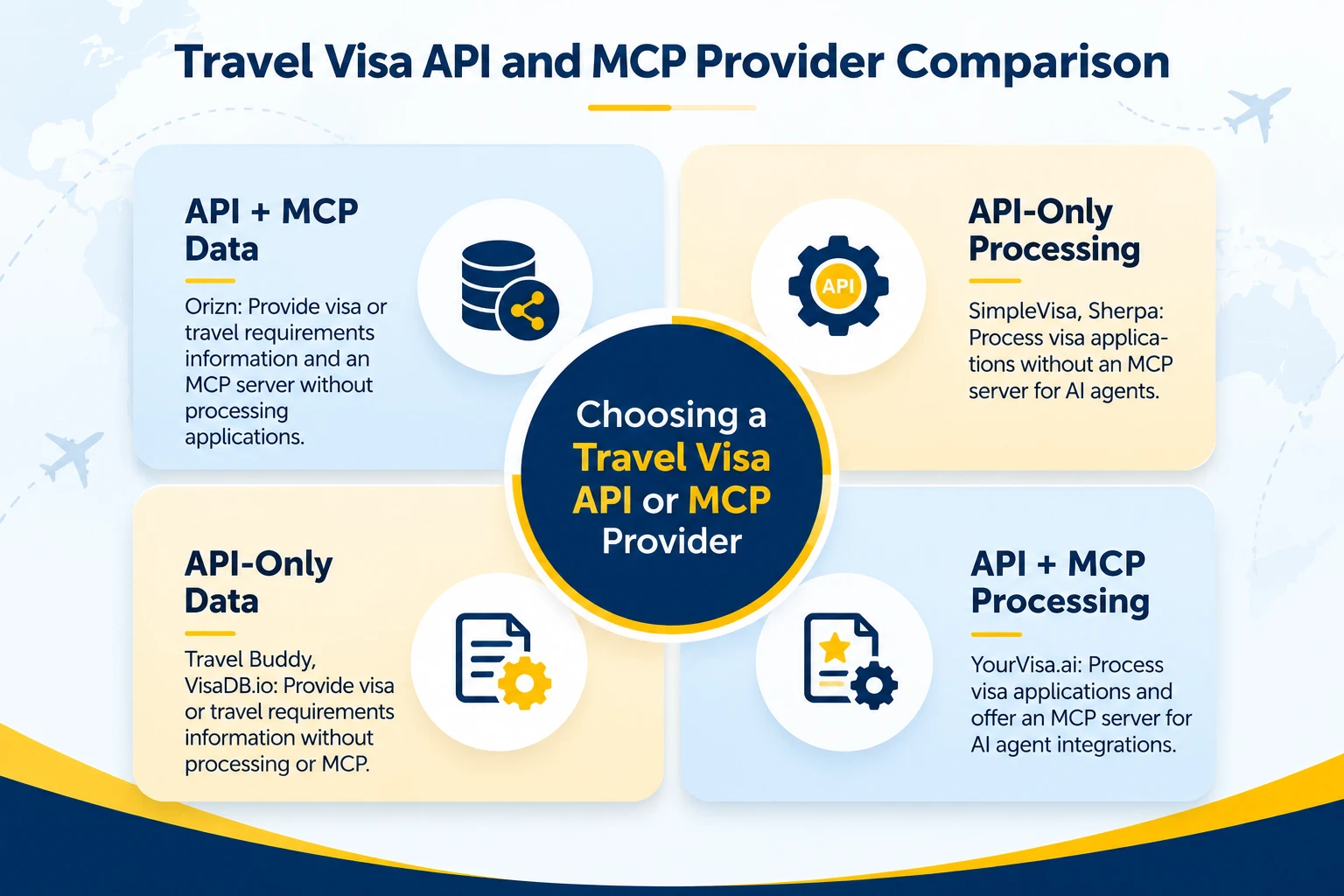
When agencies evaluate visa technology, the differences between provider types get clearer once you condense them into six criteria. Here is a fair comparison across requirements-data feeds, full-service APIs, open-source MCP servers and YourVisa.ai.
Comparison Based on Criteria
- Coverage
- Requirements-Data Providers: Airline-grade breadth, often global
- Full-Service API Providers: Broad but varies by vendor; usually dozens of countries
- Open-Source / Directory MCP Servers: Directory listings; coverage depends on contributors
- YourVisa.ai: 45+ countries, 9 languages (per product page)
- Submission
- Requirements-Data Providers: Requirements only
- Full-Service API Providers: Application submission + status
- Open-Source / Directory MCP Servers: Rarely supports submission
- YourVisa.ai: Submission supported
- MCP Server
- Requirements-Data Providers: Not applicable
- Full-Service API Providers: Sometimes offered as an add-on
- Open-Source / Directory MCP Servers: Free, open-source, but limited
- YourVisa.ai: Hosted MCP server with tool list
- Sandbox
- Requirements-Data Providers: Not typical
- Full-Service API Providers: Developer sandbox common
- Open-Source / Directory MCP Servers: Rarely provided
- YourVisa.ai: Sandbox + webhooks
- White-Label
- Requirements-Data Providers: Not offered
- Full-Service API Providers: Occasionally via partner
- Open-Source / Directory MCP Servers: Not applicable
- YourVisa.ai: White-label embed option
- Pricing Model
- Requirements-Data Providers: Subscription or airline licensing
- Full-Service API Providers: Per-call, per-application, or platform fee
- Open-Source / Directory MCP Servers: Free, but no SLAs
- YourVisa.ai: Transparent pricing; service fee ownership clarified
Key Takeaways
- Requirements-data providers earn their reputation on airline-grade breadth, but they stop at the eligibility check.
- Full-service APIs handle submission and status as well, though the integration effort varies between vendors.
- Open-source MCP servers are free and useful for experimentation. They rarely handle applications and don't carry SLAs.
- YourVisa.ai offers a balanced package: 45+ countries, 9 languages, a hosted MCP server, a sandbox with webhooks and a white-label embed option.
Each model has its own strengths. The right choice depends on whether you prioritize coverage, submission, agent-readiness or an instant launch.
Which Provider Fits Your Platform: OTA, TMC, Airline, or AI Assistant?
Different travel platforms have different needs, and the right provider depends on where the visa check sits in your workflow.
OTAs (Online Travel Agencies)
For OTAs, the priority is clarity at checkout. Travelers need to know whether they need a visa before they pay, and ideally complete the application in the same flow.
Good providers offer submission endpoints and the ability to charge an ancillary fee, which turns compliance into a revenue line while cutting post-booking friction.
TMCs and Travel Agencies
For most TMCs and agencies, back-office tracking across many travelers matters as much as the API itself. Managers need dashboards showing who is travel-ready, which applications are pending and where the compliance risks sit.
That's why a visa API MCP for travel agency setup is often the right fit: developer APIs combined with an MCP server so AI agents can assist.
If most of your volume is managed travel, you may need a visa management system for agencies alongside the API.
In this segment, the best visa management software balances submission capability with visibility across hundreds of travelers.
Airlines
Airlines focus on check-in validation and pre-departure re-checks. The provider has to integrate with departure control systems to flag passengers without the required authorization before boarding.
Airline-grade breadth is critical here. Submission features matter less.
AI Assistants or Agents
For AI assistants the order flips: MCP server first, API second. An MCP server exposes visa tools in a standardized way and lets agents discover and call them without a custom integration.
APIs still matter, but as the underlying data and submission layer.
Bottom line:
- OTAs need compliance at checkout.
- TMCs need tracking and visibility for risk management.
- Airlines need proof at check-in.
- AI assistants need an MCP server to work through.
Different provider types suit different ways of operating, and choosing the right one is what protects compliance, revenue and traveler confidence at the same time.
What Questions Should You Ask a Visa API Vendor Before Signing?
Here is a checklist you can take into a vendor call. Each question is self-contained, with what to ask, what a good answer sounds like, and one red flag.
1. What happens when a country changes its visa rules overnight?
Ask: how do you detect and push sudden government rule changes?
A good answer: automated feeds, near real-time refresh, proactive alerts.
Red flag: the vendor pushes those changes once a month.
2. How often is your data refreshed, and from which sources?
Ask: what is your stated refresh cycle and source list?
A good answer: daily checks against official portals, with push updates.
Red flag: no stated cycle at all. Airlines work to an airline-grade data standard, and your vendor should be able to show how it matches that rigor.
3. How are errors and rejections reported back?
Ask: what error codes and rejection messages do we see?
A good answer: structured error reporting with clear remediation steps.

Red flag: “you'll need to email support.”
4. Do you only return requirements, or also submit applications and return status?
Ask: is submission and status polling included?
A good answer: endpoints for requirements, submission and status.
Red flag: requirements only.
5. Who owns the traveler relationship?
Ask: does the provider contact travelers directly, or do we?
A good answer: the agency keeps ownership and the provider stays invisible.
Red flag: the provider emails travelers without your consent.
6. What are your exit terms and data portability options?
Ask: can we export traveler records if we leave?
A good answer: clear portability, CSV/JSON export, defined exit terms.
Red flag: “data stays with us.”
7. Do you provide a sandbox for testing?
Ask: is there a developer sandbox with sample responses?
A good answer: a full sandbox, scoped API keys and webhooks.
Red flag: no sandbox.
8. How does your data feed into compliance workflows?
Ask: can we integrate with document checks before submission?
A good answer: API hooks into your automation pipeline.
Red flag: manual copy-and-paste between systems.
9. What's your pricing model?
Ask: do you charge per call, per application, revenue share, or via a platform fee?
A good answer: a transparent pricing breakdown that also clarifies service fee ownership up front.
Red flag: “contact our sales department for pricing.”
10. What SLAs and escalation paths do you offer?
Ask: how do you handle outages and portal changes?
A good answer: an SLA with uptime commitments and a defined escalation path.
Red flag: no SLA.
Three red flags to watch for
- No sandbox.
- No stated data-refresh cycle.
- A country count with no breakdown by authorization type.
This checklist helps you pick a provider that can handle volatility, protect your traveler relationships and keep compliance workflows running.
How to Run a 30-Day Provider Evaluation
A structured month avoids surprises and gets you to the right partner. Here is a four-week flow.
Week 1 – Shortlist and Scorecard
Identify three or four providers and build a scorecard covering coverage, submission, MCP readiness and pricing.
Week 2 – Sandbox Test
Run 20 real passport–destination pairs through each provider's sandbox to check accuracy, refresh speed and error handling.
Week 3 – MCP and Support Test
Test the MCP or agent integration, then file a support ticket to measure responsiveness and escalation quality.
Week 4 – Commercial Terms
Review pricing, SLAs, exit terms and data portability, then decide.
Why This Works
- Week 1 makes sure you are comparing like with like.
- Week 2 validates real-world accuracy using actual travel scenarios.
- Week 3 tests technical interoperability and human support, which is what matters when rules change overnight.
- Week 4 closes with commercial clarity on costs, commitments and exit options.

The four steps cover the technical, operational and commercial sides. After 30 days you'll be confident not only in a provider's feature list but in how it handles real travelers, real changes and real support needs.
FAQs
What does a travel visa API provider do?
A visa API provider supplies structured visa requirements for passport–destination pairs. Full-service APIs also handle application submission and status tracking. The goal is to embed compliance checks directly into booking flows, which reduces denied-boarding risk for agencies and corporates.
Is a visa MCP server the same as a visa API?
No. Developers call a visa API directly to fetch requirements or submit applications. A visa MCP server exposes those same capabilities as standardized tools AI agents can discover and call. Think of MCP as the agent-ready layer on top of an API.
Do travel agencies need an API, an MCP server, or a white-label portal?
Agencies often combine them. A visa API MCP for travel agency setup suits agencies with developers and AI assistants. Agencies without an engineering team may prefer a white-label portal. It depends on whether you need submission tracking, agent-ready tools, or the best visa management software for managed travel.
How long does it take to integrate an eVisa API?
Integration times vary by vendor. Some cite medians of 5 to 15 days, depending on developer resources and scope. A good provider offers sandbox access, sample responses and clear documentation to speed up testing.
How do visa API providers charge?
Pricing models include per call, per application, revenue share or platform fees. Ask who keeps the service fee, and compare quotes against the full cost of building in-house, including the maintenance when government portals change.
Can a visa API check ETA, ESTA and ETIAS as well as visas?
Yes, comprehensive APIs cover multiple authorization types. Always ask for a country-by-type matrix rather than a headline country count, so you know exactly which authorizations are supported and where the gaps are.
Test a Travel Visa API MCP Setup on Your Own Routes
Run your top 20 passport–destination pairs through YourVisa.ai's sandbox, then connect an AI agent to the hosted MCP server in the same week. If the coverage and response format fit your checkout, integration typically takes days rather than a quarter.